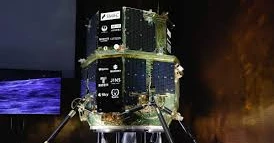
A Japanese lunar lander developed by private company ispace crashed during its descent on Friday, marking another setback in the growing commercial space race to the moon.
Tokyo-based ispace declared the mission unsuccessful after losing contact with the lander less than two minutes before its scheduled touchdown. Despite efforts to re-establish communication, flight controllers were met with silence and eventually ended the mission.
The spacecraft, named Resilience, had appeared to be descending smoothly before communications suddenly ceased. The mission was carrying a mini rover intended to explore the lunar surface.
This is ispace's second failed attempt to land on the moon. CEO and founder Takeshi Hakamada expressed regret, apologizing to the entire team and supporters. The company's first attempt also ended in a crash landing in 2022, prompting the name Resilience for the follow-up mission.
A preliminary investigation indicates that a malfunction in the lander’s laser-based altitude system may have caused it to descend too quickly, leading to a hard impact on the lunar surface.
“Given that this is our second failed attempt, we are taking the issue very seriously,” Hakamada told reporters. Still, he emphasized that ispace will continue pursuing future moon missions.
Launched in January from Florida, Resilience entered lunar orbit last month. It shared a SpaceX launch with Firefly Aerospace’s Blue Ghost, which made a successful landing in March—the first by a private company. Another U.S. firm, Intuitive Machines, also landed on the moon shortly after, though its lander toppled into a crater and ceased functioning soon after touchdown.
Unlike previous missions targeting the moon’s challenging south pole, ispace aimed for a relatively flat area in Mare Frigoris, also known as the Sea of Cold, located in the northern region of the moon’s near side.
Resilience was expected to deploy a European-built rover named Tenacious, equipped with a high-definition camera and a small shovel to collect lunar soil for NASA. Weighing only 5 kilograms (11 pounds), the rover was designed to travel slowly and stay within a kilometer of the lander.
In addition to scientific tools, the rover also carried a symbolic artistic payload—a miniature red Swedish-style house with white trim and a green door, called the "Moonhouse," created by artist Mikael Genberg.
Before the attempted landing, Hakamada assured stakeholders that lessons from the previous failure had been fully applied to this mission. “Our engineers did everything they could,” he said, calling the attempt a “stepping stone” toward future lunar ambitions, including a larger lander project in partnership with NASA set to launch by 2027.
Still, the company faces financial constraints. “We don’t have infinite funds,” said Jeremy Fix, chief engineer for ispace’s U.S. branch, at a recent conference. Although the exact cost of this mission was not disclosed, officials said it was less than the $100 million spent on the previous one.
The competition for private lunar exploration remains intense. Two other U.S. companies—Jeff Bezos' Blue Origin and Astrobotic Technology—are planning moon missions by the end of the year. Astrobotic’s first lander failed to reach the moon in 2024, reentering Earth’s atmosphere and burning up.
While private firms race to join lunar history, only five nations—Russia, the U.S., China, India, and Japan—have achieved successful robotic landings. Among them, the U.S. remains the only country to land humans on the moon, with 12 astronauts making the journey between 1969 and 1972.
NASA aims to send four astronauts around the moon in 2026, followed by a manned landing using SpaceX's Starship. Meanwhile, China has announced plans to land its astronauts on the moon by 2030.