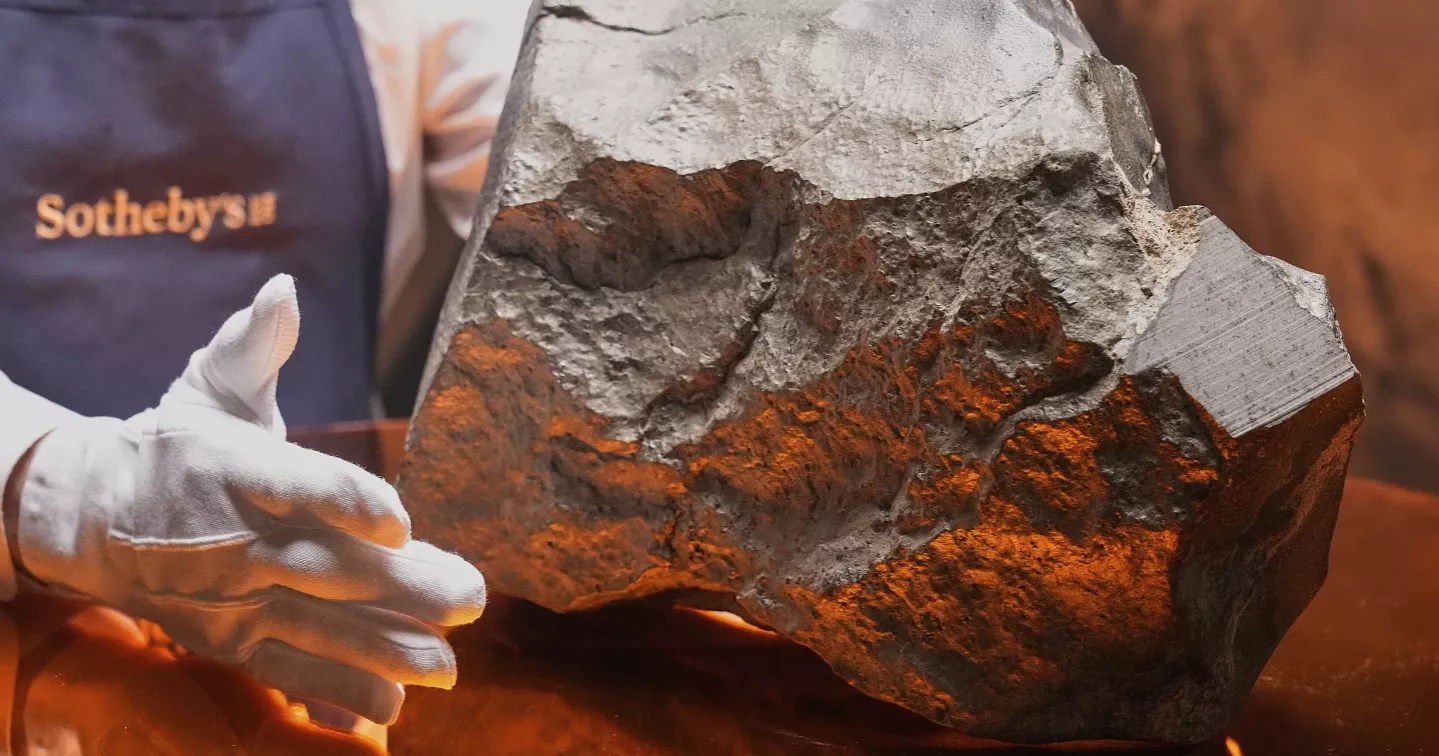
A 54-pound (25-kilogram) Martian meteorite — the biggest ever discovered on Earth — is set to go under the hammer at Sotheby’s in New York on Wednesday, with an estimated price tag of $2 million to $4 million.
Named NWA 16788, the meteorite is being offered as part of a natural history-themed auction that also includes a juvenile Ceratosaurus skeleton standing over 6 feet tall and nearly 11 feet long.
According to Sotheby’s, the meteorite likely originated from a colossal asteroid impact on Mars, which blasted it into space. After traveling approximately 140 million miles (225 million kilometers), it eventually crash-landed in the Sahara Desert. It was discovered by a meteorite hunter in Niger in November 2023.
The red, brown, and gray rock is roughly 70% larger than the next-biggest Martian fragment found on Earth and makes up nearly 7% of all confirmed Martian material on the planet. Measuring about 15 x 11 x 6 inches (375 x 279 x 152 millimeters), it is being hailed as an extraordinary find.
“This is the largest piece of Mars we’ve ever recovered — by a wide margin,” said Cassandra Hatton, Sotheby’s vice chairman for science and natural history. “It’s more than twice the size of what was previously considered the largest Martian meteorite.”
UN: Sand and dust storms impact 330 million people across 150 countries
Out of more than 77,000 officially documented meteorites, only 400 have been confirmed as originating from Mars, Sotheby’s noted.
A fragment of the meteorite was analyzed in a specialized lab and confirmed to match the chemical signature of Martian rocks studied during NASA’s Viking mission in 1976. Experts identified the specimen as an “olivine-microgabbroic shergottite,” a volcanic rock formed from slow-cooling Martian magma. Its coarse-grained texture includes minerals such as pyroxene and olivine.
The meteorite also features a glassy crust, likely formed when it was superheated while entering Earth’s atmosphere — a clue that distinguished it from ordinary Earth rocks.
Previously displayed at the Italian Space Agency in Rome, the meteorite’s current owner has not been publicly named. While the exact date it fell to Earth remains uncertain, tests suggest the impact occurred in recent years.
Also up for auction is a rare juvenile Ceratosaurus nasicornis skeleton, excavated in 1996 from Wyoming’s Bone Cabin Quarry — a renowned fossil site. The skeleton, assembled from nearly 140 fossilized bones and some sculpted material, has been mounted and is ready for exhibition.
Believed to date back about 150 million years to the late Jurassic period, the dinosaur skeleton is valued at $4 million to $6 million. Ceratosaurus was a bipedal predator with short arms, resembling a smaller version of the Tyrannosaurus rex. While Ceratosaurus could reach up to 25 feet in length, T. rex grew as long as 40 feet.
The skeleton was most recently held by Fossilogic, a Utah-based fossil preparation and mounting firm.
Earth's rotation speeding up, leading to slightly shorter days: Report
The auction is part of Sotheby’s “Geek Week 2025” and features 122 items, including additional meteorites, fossils, and rare minerals.
Source: Agency