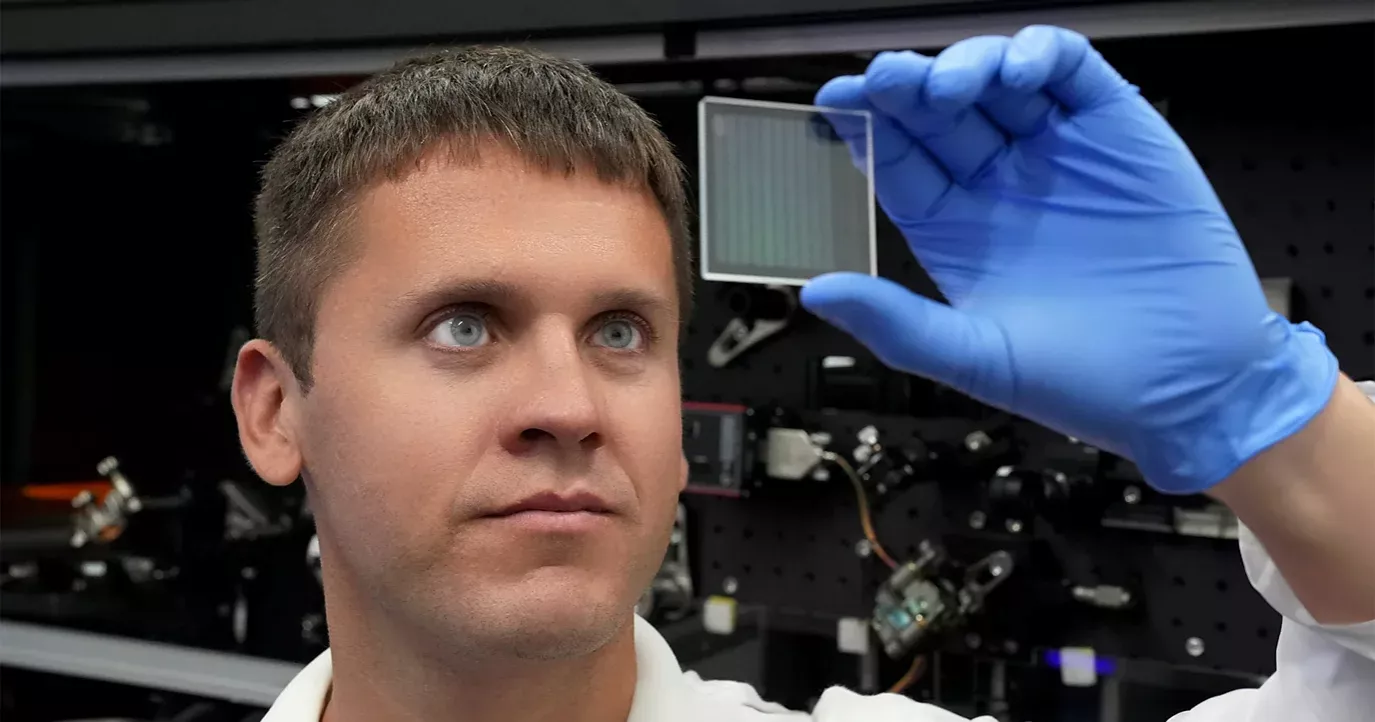
British scientist Peter Kazansky and his team have developed “memory crystals,” a glass-based data storage technology that could dramatically reduce energy consumption in data centres.
The innovation stems from a discovery at Japan’s Kyoto University in 1999, where researchers observed unusual light patterns inside silica glass exposed to ultrafast femtosecond lasers. These nanostructures, invisible to the naked eye, allow data to be encoded in five dimensions, offering extremely high storage density and near-permanent preservation.
Unlike conventional hard drives or magnetic tape, memory crystals require energy only during the data-writing process, significantly lowering ongoing power demand. Each 5-inch crystal can theoretically store up to 360 terabytes of data.
Data centres currently consume about 1.5% of global electricity, a figure expected to double by 2030, with carbon emissions potentially reaching 2.5 billion tonnes annually. Kazansky’s company, SPhotonix, launched in 2024, aims to deploy prototypes in commercial data centres within the next few years.
Experts caution, however, that widespread adoption faces hurdles due to compatibility issues with existing infrastructure. Meanwhile, alternative solutions such as DNA-based storage are also being explored for long-term, energy-efficient data archiving.
Kazansky said memory crystals could offer a sustainable solution to the world’s rapidly growing “cold data” storage needs while complementing conventional systems for everyday computing.
With inputs from BBC