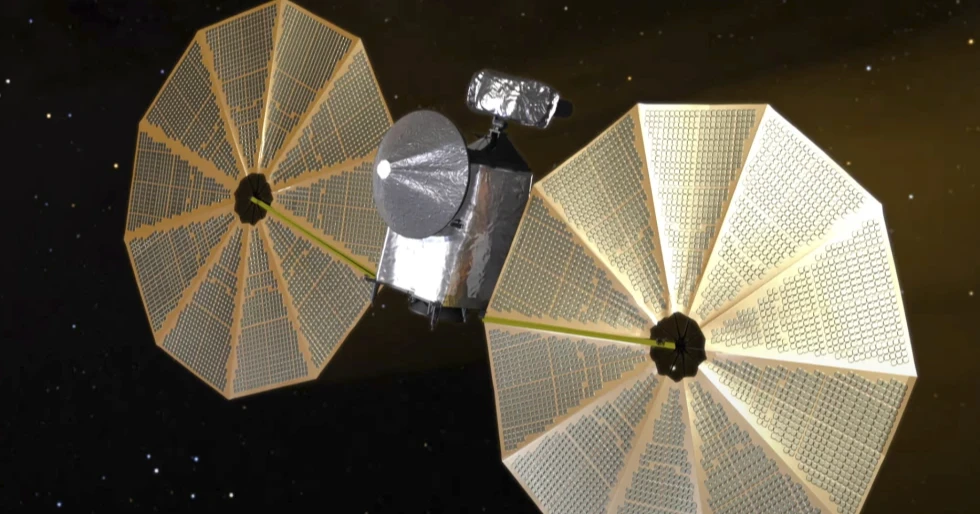
NASA’s Lucy mission has just delivered a fresh batch of space snapshots, capturing a strange, elongated asteroid during a high-speed flyby — and scientists are already buzzing about its odd shape and surprising size.
The flyby, which took place Sunday, gave Lucy its closest look yet at the asteroid named Donaldjohanson, located in the main asteroid belt between Mars and Jupiter. The images, released by NASA on Monday, show a lumpy, misshapen rock stretching about 5 miles (8 kilometers) long and 2 miles (3.5 kilometers) wide — bigger than scientists had expected.
The asteroid’s long, pin-like form was so extensive that Lucy couldn’t fit it entirely into the first images beamed back to Earth. Additional data expected in the coming days should help researchers piece together a clearer picture of its full shape and surface details.
Lucy came within just 600 miles (960 kilometers) of Donaldjohanson, a safe distance for this observational mission. Though the asteroid itself poses no threat, the encounter served as a vital test run for the spacecraft as it prepares for the main event: a tour of the Trojan asteroids that orbit the sun near Jupiter.
Scientists find possible chemical signs of life on a faraway planet
The asteroid is named after paleoanthropologist Donald Johanson, who co-discovered the famous "Lucy" fossil in Ethiopia in 1974 — the namesake of the spacecraft.
Launched in 2021, the Lucy mission is on a 12-year journey to explore these ancient celestial bodies. The flyby of Donaldjohanson marks a successful milestone as the spacecraft gears up for a series of eight Trojan asteroid visits through 2033.
With this latest encounter in the books, scientists are eager to analyze the incoming data and gain deeper insights into the asteroid’s structure — and get Lucy ready for the more complex missions still to come.