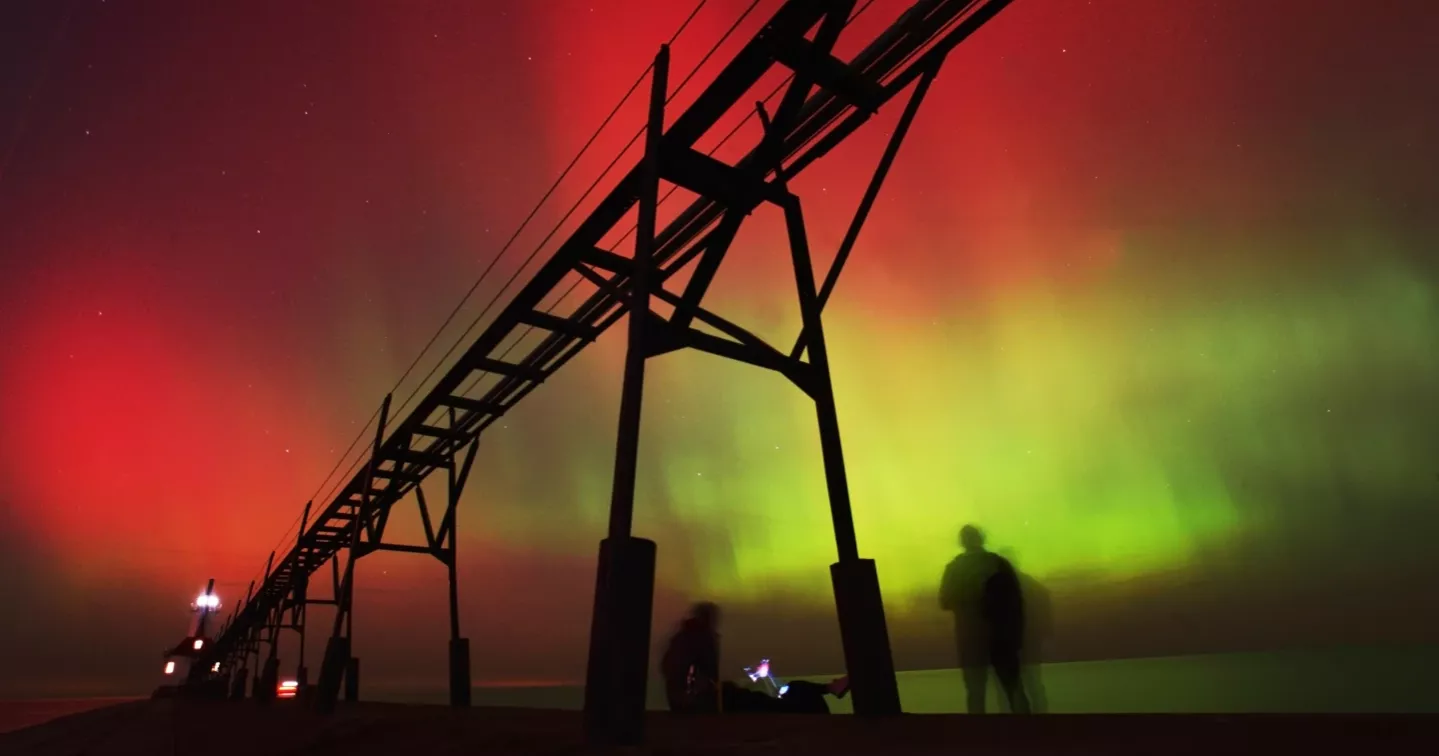
Colorful northern lights may light up the night sky across several northern U.S. states on Thursday night, thanks to an incoming solar storm triggered by a massive burst of energy from the sun.
The sun recently released a coronal mass ejection (CME) — a huge expulsion of charged particles — that is heading toward Earth. Space weather forecasters have issued a strong geomagnetic storm watch, with the solar burst expected to arrive between Thursday evening and early Friday.
According to Shawn Dahl, a space weather forecaster at the U.S. National Oceanic and Atmospheric Administration (NOAA), the strength and reach of the auroras will depend on the timing and interaction of the solar particles with Earth’s magnetic field. “If the timing lines up, auroras will quite likely spin up overnight,” Dahl said in an email.
Authorities are monitoring the situation but do not expect significant disruptions to communications or radio signals, he added.
Auroras could be visible — particularly in darker, rural areas — across Alaska, Washington, Oregon, Idaho, Montana, Wyoming, North Dakota, South Dakota, Nebraska, Minnesota, Iowa, Michigan, Wisconsin, New York, Vermont, New Hampshire, Maine, and northern parts of Illinois, Indiana, Ohio, Pennsylvania, and Massachusetts.
However, the bright moon may make the lights harder to spot. If solar activity continues, the northern lights could also be visible on Friday night.
Why northern lights appear
The sun is currently at the peak of its 11-year activity cycle, making aurora sightings more frequent and widespread. Auroras — commonly visible near the poles — occur when charged particles from the sun collide with Earth’s atmosphere, producing vivid displays of green, pink, and purple light.
As the sun’s magnetic poles prepare to swap places in this cycle, solar flares and geomagnetic disturbances become more intense. Last year, Earth experienced its strongest geomagnetic storm in two decades, lighting up skies across the Northern Hemisphere, including Germany, the UK, New England, and even New York City.
NASA and NOAA expect the sun’s heightened activity to last through the end of the year, although the exact peak of the cycle won’t be known until months afterward.
When solar storms turn dangerous
While often beautiful, solar storms can also disrupt technology on Earth. High-energy particles can interfere with power grids, satellites, GPS, and air traffic communications.
In 1859, one of the most severe solar storms ever recorded caused auroras as far south as Hawaii and even set telegraph lines ablaze. Another event in 1972 reportedly detonated magnetic sea mines off Vietnam’s coast.
Scientists cannot predict solar storms months in advance. Instead, they issue alerts only a few days before the charged particles are expected to reach Earth.
How to watch the auroras
To maximize the chance of seeing the northern lights, experts advise heading to a dark, open area away from city lights, such as a local or national park. Weather conditions are crucial — cloud cover can easily obscure the spectacle.
Aurora forecasts are available on NOAA’s Space Weather Prediction Center website or through dedicated aurora-tracking apps.
For sky watchers, capturing a photo with a smartphone camera can sometimes reveal faint aurora colors invisible to the naked eye — making the celestial show even more memorable.
Source: AP