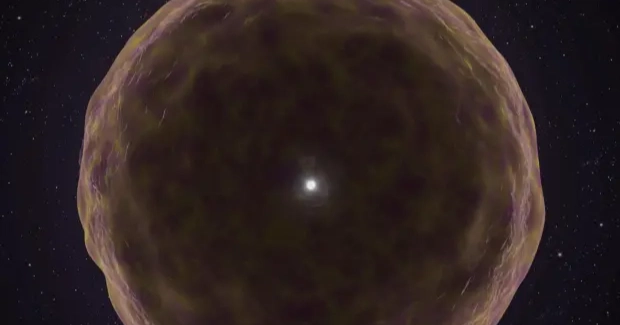
Scientists have, for the first time, observed the inner layers of a dying star as it exploded, giving a rare glimpse into stellar evolution.
Stars live for millions to trillions of years before running out of fuel. The largest ones end in powerful explosions called supernovas. Astronomers have long studied these blasts, but the violent process usually scrambles the star’s layers, making it difficult to see its inner structure.
Scientists uncover ancient whale with Pokémon-like face and sharp teeth
This time was different. Researchers spotted a supernova named 2021yfj, located in the Milky Way galaxy, that revealed its core layers. The star had lost its outer shells of hydrogen and helium much earlier, but unusually, its dense inner layers of silicon and sulfur were also stripped away.
“We have never observed a star that was stripped to this amount,” said Steve Schulze of Northwestern University, part of the discovery team. Their findings were published Wednesday in the journal Nature.
The discovery supports theories that massive stars are built in layers, with lighter elements on the outside and heavier ones closer to the core. “Because so many of the layers had been stripped off this star, this basically confirmed what those layers were,” said Anya Nugent of the Harvard-Smithsonian Center for Astrophysics, who was not part of the study.
Scientists remain unsure how the star became so bare — whether its layers were blown off in its final stages or pulled away by a companion star. They say catching another such event will be difficult but could provide new insights into how stars die.
Source: Agency