
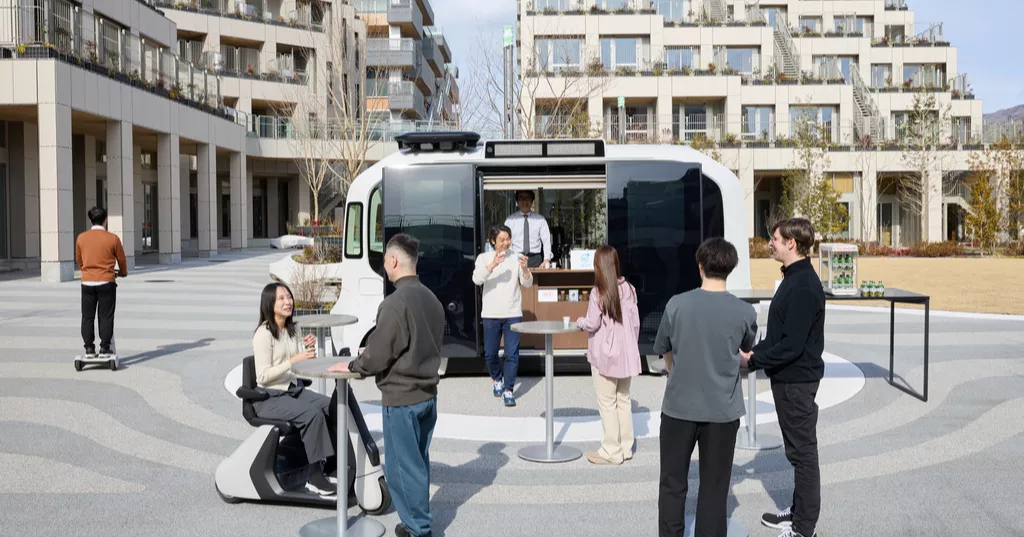
Toyota's Woven City, located near Mount Fuji, is designed as a testing ground for robotics, artificial intelligence, and autonomous zero-emission transportation in daily life.
Daisuke Toyoda, a project executive from Toyota’s founding family, emphasized that it is not a "smart city" but rather a "test course for mobility," differentiating it from real estate development.
On Saturday, during a tour of the site where the first phase of construction has been completed, The Associated Press became the first foreign media outlet to preview the $10 billion project.
The initial phase covers 47,000 square meters (506,000 square feet), roughly the size of five baseball fields, and the entire project will eventually span 294,000 square meters (3.1 million square feet).
Built on the site of a former Toyota Motor Corp. factory, Woven City aims to be a hub for researchers and startups to collaborate and exchange ideas, according to Toyoda.
Many ambitious smart city projects have struggled or remained unfinished, including Google's Alphabet-backed initiative in Toronto, Saudi Arabia's "Neom," a development near San Francisco led by a former Goldman Sachs trader, and Masdar City in Abu Dhabi.
Construction of Woven City began in 2021. The buildings are interconnected by underground passageways, where autonomous vehicles will handle tasks like garbage collection and deliveries.
Currently, no one resides there, but the first 100 residents—referred to as "weavers"—will include employees from Toyota and its partner companies, such as instant noodle manufacturer Nissin and air-conditioning maker Daikin. At the site, coffee brand UCC was already serving hot drinks from an autonomous bus stationed in a plaza surrounded by empty apartment buildings.
The city's name pays tribute to Toyota's origins as an automatic textile loom manufacturer. Daisuke Toyoda’s great-great-grandfather, Sakichi Toyoda, originally invented the loom to ease his mother’s labor-intensive work.
Unlike other projects focusing on electric vehicles, Toyota has prioritized hydrogen as the primary energy source for Woven City, despite lagging behind competitors like Tesla and BYD in the EV market.
Toyota does not anticipate generating profits from Woven City anytime soon. However, auto analyst Keisuke Konishi from Quick Corporate Valuation Research Center suggests that Toyota is investing in robotic mobility to compete with Google's Waymo—even if it requires building an entire city to do so.
“Toyota has the financial resources to make it happen,” he said.