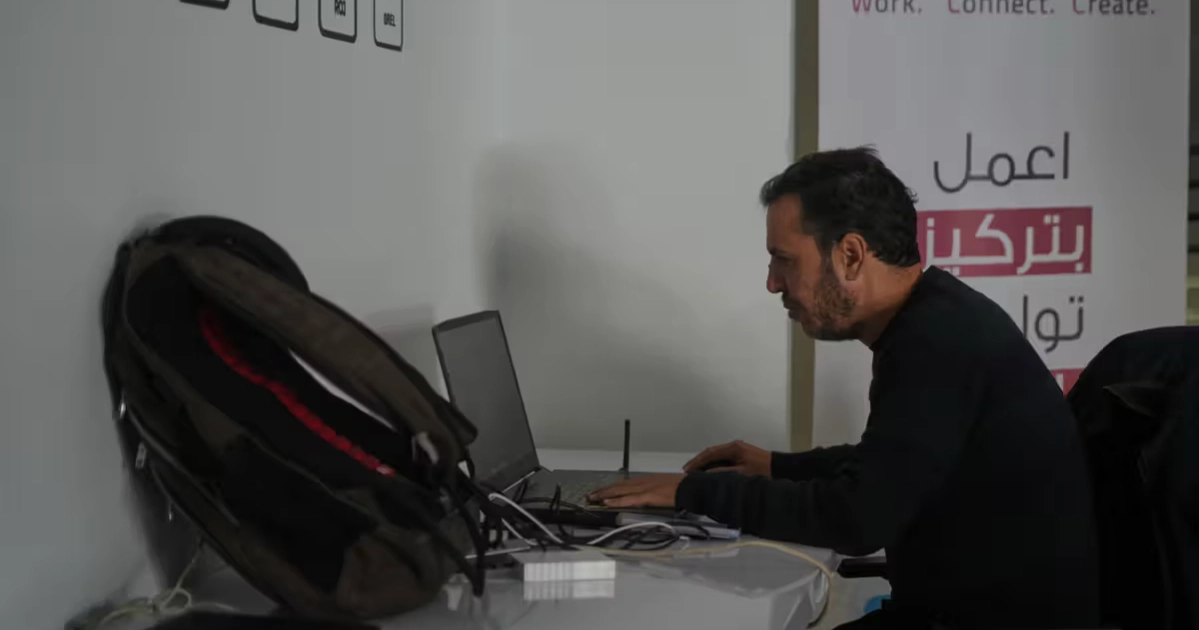
Amid constant drone noise, blackouts and damaged streets, some young tech workers in Gaza are still trying to earn a living by coding for clients abroad.
Tarik Zaeem, a 44-year-old programmer, spends his days working on software for an app in Saudi Arabia, fixing issues in a barcode system while sitting at a laptop in Gaza City. He often walks through destroyed streets to reach a shared workspace where freelancers can charge devices and access more stable internet.
Remote work has become both a vital income source and a mental escape for many in the war-hit territory.
“When I work, I forget everything and focus on coding,” he said, adding that his wife and children are now in Egypt. “I stop thinking about airstrikes or searching for drinking water.”
Zaeem is part of a growing community of freelancers in Gaza who work for international clients through platforms such as Upwork, Freelancer.com and Mostaql. Despite the ongoing war and widespread destruction, many continue to design websites, build apps and create digital services for clients in countries including Canada, Kuwait and Turkey.
The digital freelancing sector in Gaza developed over the past decade, especially after traditional industries weakened following political changes and restrictions. High unemployment and widespread internet access helped push many graduates toward online work, while donors and NGOs supported training programs and tech hubs.
One such initiative, Mercy Corps’ Gaza Sky Geeks, once ran busy coworking spaces before much of its infrastructure was destroyed during the war. The group is now helping revive remote work through smaller shared workspaces.
However, the conflict has severely disrupted daily life. Telecommunications networks were heavily damaged, and frequent power cuts have made it difficult for freelancers to meet deadlines. Many have also lost homes, relatives and stable internet access due to airstrikes and displacement.
Software engineer Sharif Naim, who runs a solar-powered coworking space called Taqat Gaza, said working conditions have slowly improved as new shared workspaces opened across the territory. His centre now supports hundreds of freelancers with internet access and training.
Women have also increasingly relied on online work as households face growing financial pressure. Graphic designer Reem Alkhateeb said freelancing has become her family’s main income source after her husband lost his job and food and water shortages worsened.
“Our dreams are now very basic,” she said. “We just want electricity, internet and a normal life where we can work.”Getting paid remains another major challenge. Many freelancers cannot access international banking services or payment platforms, forcing them to rely on relatives abroad or informal cash transfer systems with high fees.
In response, local initiatives such as “Gaza Talents,” founded by Salsabil Bardawi after personal loss in the war, are helping connect freelancers with international clients and manage payments through partner financial services. The platform says it has helped generate hundreds of thousands of dollars in income for workers.
Despite the hardships, many freelancers say they continue working not only for survival, but also to maintain a sense of normal life in the midst of destruction.