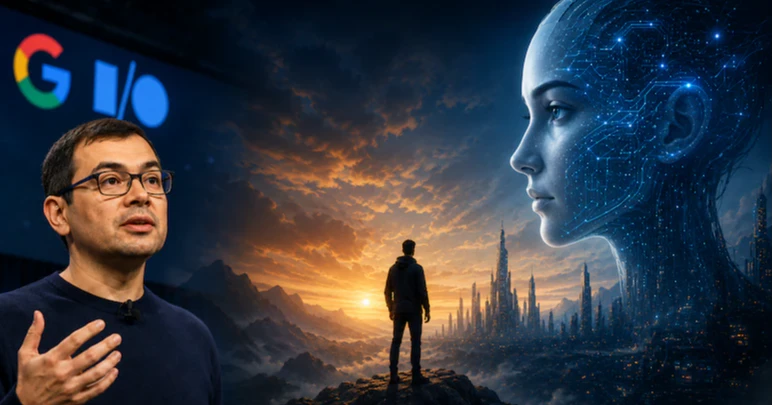
Demis Hassabis, the head of Google DeepMind, says artificial general intelligence (AGI) is now “on the horizon,” suggesting that a major breakthrough in AI could be closer than many expected.
Speaking at Google I/O, Hassabis said AGI could one day help solve all diseases and that humanity may be approaching the “foothills of singularity,” a theoretical point when AI surpasses human intelligence.
AGI refers to a form of AI capable of matching or exceeding human abilities across nearly all cognitive tasks, unlike today’s systems, which are designed for specific jobs such as generating text, analysing images or making recommendations.
Hassabis did not give a specific timeline during his keynote. However, he has previously estimated that AGI could arrive within five to eight years.
The comments drew attention because they came from one of the world’s most respected AI researchers. Hassabis, who has received global recognition for his work in artificial intelligence, is considered a leading voice in the field.
During the conference, Google also demonstrated AI tools designed to handle online shopping, manage tasks and browse the internet like a personal assistant.
Some experts welcomed the optimism but warned that the definition of AGI remains unclear.
Ansh Mehra, founder of The Cutting Edge Group and an AI educator, said many researchers still disagree on what AGI actually means.
He told NDTV that AGI may still be three to four years away, but added that even the concept of intelligence itself is still debated.
Other experts believe AGI may take much longer.
Dr Srinivas Padmanabhuni, chief technology officer of AiEnsured, said common-sense reasoning and modeling consciousness remain major scientific challenges. He estimated that AGI could still be 10 to 15 years away.
Some critics argue that AGI has become a powerful marketing concept in Silicon Valley, where ambitious promises often outpace practical results.
Still, AI is already transforming scientific research. Systems developed by companies such as Google are being used to predict protein structures, improve medical imaging and speed up drug discovery.
Hassabis also suggested that advanced AI could revolutionise medicine by processing vast amounts of biological and medical data much faster than humans.
Researchers say such systems could accelerate the development of new treatments for cancer and other complex diseases and may even help extend human life by advancing research on ageing.
While experts remain divided over when AGI will arrive, many agree that progress in AI is moving rapidly and could reshape science, medicine and society in the coming decades.
#From NDTV