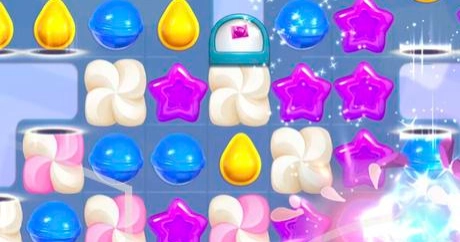
Candy Crush Saga players navigating the game’s more than 18,700 levels may not realize that artificial intelligence is quietly helping shape their puzzle-solving experience.
The wildly popular mobile game, developed by Swedish studio King, uses AI tools to assist in designing and tweaking levels to keep players engaged — whether they’re first-timers or seasoned veterans looking for fresh challenges. Developers also rely on AI to revise older levels, helping to prevent users from getting stuck or losing interest.
According to Todd Green, general manager of the Candy Crush franchise, AI helps relieve some of the burden on developers. “It would be extremely difficult,” he said, to update and manage so many levels manually. With AI doing an initial pass, designers are free to focus on building new puzzle boards.
In the broader gaming world, the role of AI in development is still being debated. Some see it as a way to streamline repetitive tasks and enhance games with smarter non-player characters. Others view it as a potential job threat — a concern serious enough that game performers with the Screen Actors Guild-American Federation of Television and Radio Artists went on strike last July over AI-related issues.
“We’re not putting chatbots into the game. We’re not putting AI-powered design experiences into the game for players directly to play with,” Green clarified. “Instead, we’re trying to deploy AI on existing problems that we have in order to make the work of the teams faster or more accurate, and more accurate more quickly.”
Data from the Entertainment Software Association shows that U.S. consumer spending on video game content rose to $51.3 billion in 2024, up from $49.8 billion the year before. Mobile games, including Candy Crush, make up about half of that figure and are now the top gaming choice for players aged 8 and up.
Candy Crush, which debuted on Facebook in 2012, has undergone constant evolution. King has now released 300 different client versions of the game. Activision Blizzard acquired King in 2016 for $5.9 billion.
Joost Van Dreunen, author of One Up: Creativity, Competition, and the Global Business of Video Games, said the game’s longevity and massive user base create a constant demand for new content. In that context, using AI makes sense.
“To supply that at scale, you absolutely can rely on a sort of artificial intelligence or generative AI to create the next set of forms,” he said. “The thing about Candy Crush is that every level is technically a single board that you have to solve or clear before you can advance. With AI and the existing library of human-made boards, it makes total sense to then accelerate and expand the efforts to just create more inventory. People play more levels.”
King applies AI in two primary ways: to generate new puzzles and to revisit and revise older ones — even levels released years ago — to ensure they remain enjoyable. For high-level players, the aim is to make new puzzles engaging right from the start.
“That’s hard for us to do, because we don’t get the benefit of having many players test or play through the levels and give us feedback. We have to sort of try and pitch it right at first,” Green explained. He said it’s also crucial to cater to returning players who may have taken a break and are curious about what’s new.
Instead of directly introducing AI-generated content into the game, King uses the technology behind the scenes, helping improve level design more efficiently.
“Doing that for 1,000 levels all at once is very difficult by hand,” Green said. “So the most important thing to understand here is that we are using AI as like a custom design.”
Green noted that level difficulty is intentionally varied to keep players engaged — easier puzzles may follow more difficult ones and vice versa. With AI, the team can now potentially enhance thousands of levels each week instead of just hundreds, by automating the early stages of redesign.
“We talk to players all the time,” Green said. “We also get the quantitative feedback. We can see how players respond to the levels... How easy are the levels? Do they get sort of stuck, or are they progressing in the way that we hope?”
To evaluate how players are interacting with levels, King tracks metrics such as pass rate — how often a level is beaten within 100 tries — and how frequently a level is “reshuffled,” meaning all the candies are rearranged. However, some elements are harder to quantify.
“It’s also, to some extent, obviously subjective,” Green said. “It’s different for different people.”