
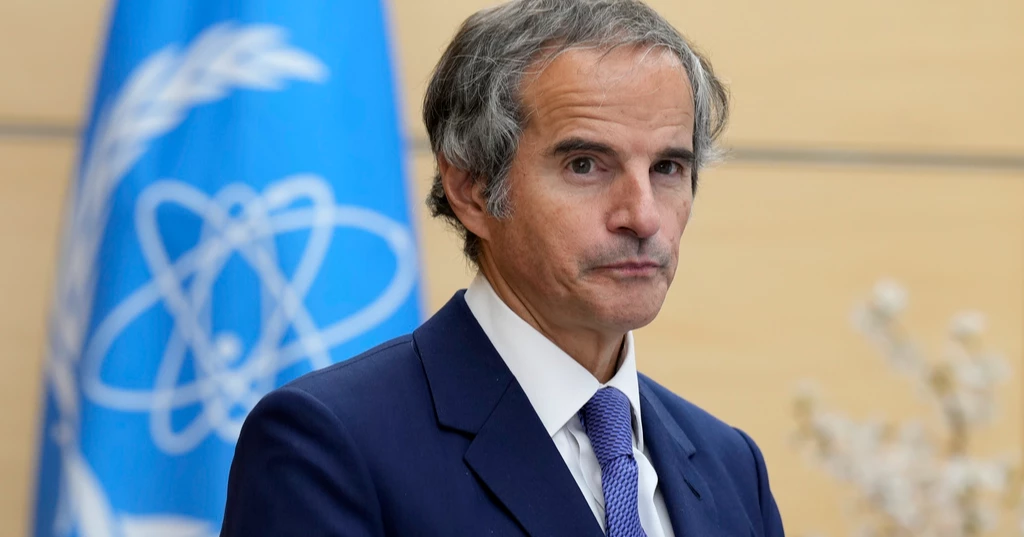
Iran is on the verge of dramatically increasing its stockpile of near-weapons-grade uranium, as it has activated cascades of advanced centrifuges, warned Rafael Mariano Grossi, the head of the International Atomic Energy Agency (IAEA), on Friday.
His remarks came shortly after Iran claimed a successful space launch, marking its heaviest payload to date, a development that the West believes enhances Tehran's ballistic missile capabilities.
The launch of the Simorgh rocket coincides with Iran's uranium enrichment at 60%, a step away from weapons-grade levels of 90%. While Iran asserts that its nuclear program is peaceful, officials are increasingly hinting at the potential development of nuclear weapons and intercontinental ballistic missiles to target distant adversaries, including the United States.
These actions are likely to escalate tensions in the broader Middle East, especially with the ongoing conflict between Israel and Hamas in Gaza and an uneasy ceasefire in Lebanon. However, Iran might also be positioning itself for possible negotiations with President-elect Donald Trump’s administration, following the U.S. withdrawal from the nuclear deal during his first term.
Bitcoin tops $100,000 as big rally sparked by Trump election win rolls on
A recent U.S. intelligence report stated that while Iran is not actively building a nuclear weapon, it is undertaking activities that would enable it to do so if it chooses. The report also warned that the debate within Iran over pursuing nuclear weapons could strengthen advocates for such a course, potentially influencing future Iranian leadership.
Grossi, speaking to journalists at the Manama Dialogue in Bahrain, said that IAEA inspectors planned to verify how many centrifuges Iran is operating after the country informed the agency of its plans. He expressed concern, noting that Iran had kept many facilities in reserve, now activating them, which could lead to a significant increase in uranium enrichment.
An IAEA statement confirmed that Iran had begun feeding uranium, enriched to 20%, into two cascades of advanced IR-6 centrifuges at its underground Fordo facility. The advanced IR-6 centrifuges enrich uranium faster than the IR-1 centrifuges, and using uranium enriched to 20% will expedite the process further.
Govt appoints administrator for BASIS
The IAEA also noted that Iran would begin feeding natural uranium into eight additional IR-6 cascades at Fordo to produce 5%-enriched uranium.
In late November, the IAEA had warned that Iran was preparing to use advanced centrifuges to enrich uranium, a move triggered by its failure to fully cooperate with the agency. Iran did not comment on the preparations.
Meanwhile, Iran’s successful Simorgh rocket launch took place at the Imam Khomeini Spaceport in Semnan province. The rocket carried an orbital propulsion system and the Fakhr-1 military satellite, marking the first time a military payload was included in Iran’s civilian space program.
The U.S. military referred questions about the launch to Space Command, which did not respond. Experts confirmed the successful insertion of the payload into orbit.
The United States has criticized Iran’s satellite launches, arguing they violate a U.N. Security Council resolution that bans activities related to ballistic missiles capable of carrying nuclear warheads. U.N. sanctions on Iran’s missile program expired in October 2023.
The U.S. intelligence community noted that Iran's space-launch vehicles, including the Simorgh, could accelerate the development of intercontinental ballistic missiles due to their shared technological similarities.
Despite Iran's denials of seeking nuclear weapons, U.S. and IAEA reports indicate that Iran had a military nuclear program until 2003. Under former President Hassan Rouhani, Iran had slowed its space program to avoid escalating tensions with the West. However, the late President Ebrahim Raisi, who took office in 2021, pushed the program forward. His successor, President Masoud Pezeshkian, has yet to announce a clear strategy on space ambitions, while the Revolutionary Guard also conducted a successful launch in September.