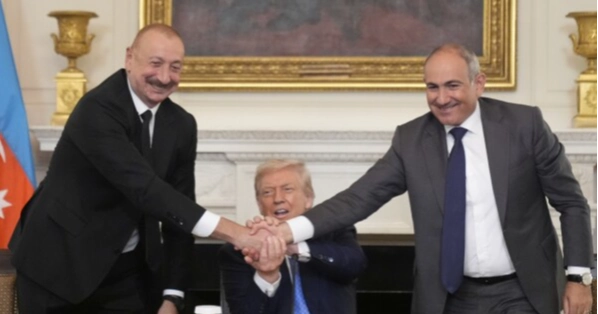
Armenia and Azerbaijan leaders shook hands Friday at a White House peace summit and signed an agreement aimed at ending decades of conflict in the South Caucasus region.
President Donald Trump stood between Azerbaijani President Ilham Aliyev and Armenian Prime Minister Nikol Pashinyan as they joined hands. Trump also clasped their hands, symbolizing unity and cooperation.
The agreement, signed by both countries and the U.S., will reopen key transportation routes and reduce Russia’s influence in the region. A major transit corridor named the “Trump Route for International Peace and Prosperity” will connect Azerbaijan and its Nakhchivan exclave, a longstanding demand from Azerbaijan. The White House called it a significant step for regional connectivity and peace.
Trump described the naming of the corridor as “a great honor” but said he did not request it. A senior administration official revealed that Armenia proposed the name.
Trump, who has sought recognition as a peacemaker, added this deal to a series of peace and economic agreements brokered by the U.S. in 2025.
Both leaders credited Trump and his team for the breakthrough. Pashinyan called the agreement a “significant milestone,” while Aliyev said Trump achieved “a miracle” in six months.
“Thirty-five years they fought, and now they’re friends and will remain so for a long time,” Trump said.
The new corridor will provide Azerbaijan a direct land link to Turkey and Europe, bypassing Armenia and improving regional trade.
Trump expressed interest in visiting the corridor and voiced confidence in lasting peace between the two countries.
Aliyev and Pashinyan joined other global leaders advocating for Trump to receive the Nobel Peace Prize for his role in resolving conflicts worldwide. Earlier this year, the U.S. helped broker peace deals involving the Democratic Republic of Congo, Rwanda, India, Pakistan, Cambodia, and Thailand.
The deal also marks a geopolitical setback for Russia, which had long mediated the Armenia-Azerbaijan conflict to maintain influence in the South Caucasus. Moscow’s power waned following its 2022 invasion of Ukraine, allowing the U.S. to expand its role.
Negotiations on developing the Trump Route — including rail, oil and gas pipelines, and fiber optics — are expected to begin soon, with multiple developers showing interest.
Separate agreements signed by Armenia and Azerbaijan with the U.S. aim to enhance cooperation in energy, technology, and the economy.
The decades-long conflict centered on the Nagorno-Karabakh region, predominantly Armenian-populated but within Azerbaijan’s borders, which led to violent clashes and thousands of deaths. Azerbaijan reclaimed the region in 2023, and the new deal includes provisions for normalized ties and a transit corridor, addressing previous sticking points.
Armenia, moving away from Russian influence after the 2023 conflict, welcomed closer ties with the U.S., while Azerbaijan has also grown more assertive in its relations with Moscow.
Source: Agency