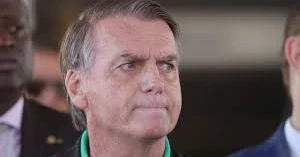
Brazil’s Supreme Court has ordered former President Jair Bolsonaro to be placed under house arrest, accusing him of orchestrating a failed coup attempt to stay in power after losing the 2022 election. The decision comes amid escalating political tensions and a trade conflict with the Trump-led U.S. administration.
Justice Alexandre de Moraes, who is overseeing the case, said Bolsonaro, 70, violated previous restrictions by spreading political content through his sons, all of whom are lawmakers.
Bolsonaro's legal team announced plans to appeal, arguing that a brief message he delivered during a protest in Rio — broadcast from his son’s phone — did not breach any conditions. The message included, “Good afternoon, Copacabana, good afternoon my Brazil... this is for our freedom.”
The case is attracting increased attention after former U.S. President Donald Trump, a strong Bolsonaro ally, linked new 50% tariffs on Brazilian imports to the legal action. Trump dismissed the charges against Bolsonaro as a "witch hunt," prompting backlash from Brazilian leaders across the political spectrum, including current President Luiz Inácio Lula da Silva.
Shortly after the court's decision, the U.S. State Department’s Bureau of Western Hemisphere Affairs posted on X condemning Bolsonaro’s house arrest and warning that those involved would be held accountable. The agency also criticized restrictions on Bolsonaro’s ability to speak publicly.
The Brazilian government has not officially commented.
Coup Plot Allegations
Prosecutors accuse Bolsonaro of leading a criminal group that sought to overturn the 2022 election results, including alleged plots to assassinate President Lula and Justice de Moraes. Following his narrow loss, Bolsonaro was previously ordered to wear an ankle monitor and follow a curfew.
After the latest ruling, Brazilian federal police reportedly searched Bolsonaro’s residence in Brasília and confiscated mobile devices, following instructions from Justice de Moraes.
Bolsonaro must now remain under house arrest in Brasília and is barred from traveling. Although he also owns a home in Rio, he cannot stay there. A former army captain and longtime congressman, Bolsonaro is now the fourth ex-president arrested since Brazil’s military dictatorship ended in 1985 — a regime he has openly supported.
Disregard for Court Orders
The arrest order came just a day after large pro-Bolsonaro rallies in São Paulo and Rio, where supporters demanded amnesty for those prosecuted over the January 8, 2023, riot in Brasília.
During the Rio rally, Bolsonaro addressed the crowd via phone using one of his sons’ devices — an act Justice de Moraes deemed illegal. De Moraes noted that Sen. Flávio Bolsonaro removed the video from Instagram in an apparent effort to hide the violation.
In response, Flávio claimed Brazil had "officially become a dictatorship," accusing de Moraes of relentless persecution.
De Moraes wrote that Bolsonaro’s recent actions show a deliberate effort to defy court orders and to encourage attacks against the judiciary — with clear support for foreign intervention, alluding to Trump’s involvement.
He added that Bolsonaro used his public message in Copacabana to rally his base against the court, calling it an attempt to “intimidate the judiciary.”
Last week, the U.S. Treasury sanctioned de Moraes for allegedly suppressing free speech in relation to Bolsonaro’s trial. On Monday, the Bureau of Western Hemisphere Affairs echoed this criticism, calling de Moraes a “sanctioned human rights abuser” and accusing him of weaponizing institutions against dissent.
De Moraes responded firmly: “Justice will not be mocked. Anyone who ignores court orders — especially repeatedly — must face consequences.”
Political Fallout and Future Implications
Political analyst Creomar de Souza said the house arrest marks a turning point in Brazil’s political landscape. It could energize the right-wing opposition ahead of the 2026 election, while Lula’s government will need to assert its leadership amid growing polarization.
According to de Souza, “The 2026 race now looks more turbulent. The opposition will push for amnesty and protest visibly, while Lula must prove the government is stable.”
The latest court order also requires Bolsonaro to remain under ankle monitoring, limits his visitors to lawyers and close family, and enforces the seizure of all cell phones in his possession.
This case echoes past events: Lula himself was imprisoned for 580 days before his conviction was annulled; Michel Temer, president after Rousseff’s impeachment, was detained briefly in 2019 but wasn’t convicted; and earlier this year, Fernando Collor, impeached in the 1990s, began serving an 8-year sentence for corruption.
Right-wing politicians criticized the court’s decision, arguing that it is politically motivated. Lawmaker Nikolas Ferreira mocked the charges, saying Bolsonaro’s arrest was not over corruption, but “because his kids posted content.”
Meanwhile, leftist lawmaker Duda Salabert praised the move, calling it a win for Brazilian democracy.
“Those who tried to destroy it will soon face justice,” she said.