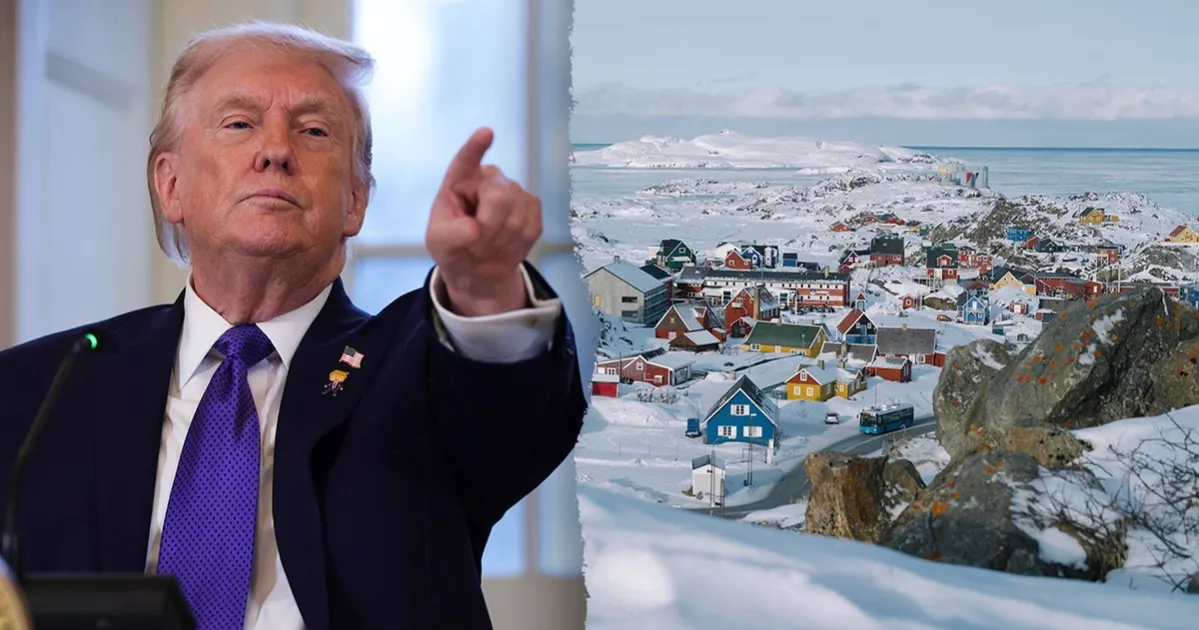
President Donald Trump’s renewed push to acquire Greenland has triggered resistance from Republicans in Congress, with lawmakers increasingly uneasy about US military involvement overseas.
However, it remains uncertain whether enough Republicans would join Democrats to stop a takeover of the island territory, or whether Trump would ignore Congress and move ahead on his own, as he has done repeatedly during a second term marked by deeper US entanglements abroad.
What began as a debate over Greenland has now widened into a broader argument over the Trump administration’s unilateral use of military force, as well as diplomatic and economic pressure, to project American power in places such as Venezuela, Iran and beyond.
Read More: Pro-Greenland protesters mock Trump's MAGA slogan with 'Make America Go Away' caps
Republicans have largely supported Trump’s foreign policy since his return to the White House. But a growing number are now siding with Democrats in Congress and Nato allies who say that any attempt to take over Greenland would breach both US and international law, reports BBC.
In recent days, several senior Republicans have said there is little appetite in Washington for buying Greenland or seizing it by force. Some GOP lawmakers have also joined Democrats in opposing Trump’s proposal to impose tariffs on countries that refuse to back his bid for the territory, which is self-governing but remains under Danish control.
The proposed tariffs would be “bad for America, bad for American businesses, and bad for America’s allies,” Senator Thom Tillis of North Carolina wrote on social media, warning that the move would benefit China and Russia. “It’s great for Putin, Xi and other adversaries who want to see Nato divided.”
Other Republicans said Trump’s ambition to annex Greenland risked weakening the Nato alliance, of which both the United States and Denmark are members, at a time of growing strain between Washington and its European partners.
Read More: US forces seize seventh Venezuela-linked oil tanker amid Trump oil crackdown
“Respect for the sovereignty of the people of Greenland should be non-negotiable,” said Senator Lisa Murkowski, co-chair of the Senate Arctic Caucus.
Trump has argued that the US must control the territory to compete more effectively with China and Russia in the Arctic and has vowed to take it “one way or another”.
On Tuesday, he brushed aside concerns that the issue could damage Nato. Asked by the BBC whether he was prepared to see the decades-old security alliance collapse over Greenland, Trump repeated his view that ownership of the island was vital for US and global security.
“We need [Greenland] for national security and even world security,” he said.
Despite Trump’s insistence, the plan is becoming increasingly unpopular on Capitol Hill.
If Republicans and Democrats decide to confront the president, Congress has several tools at its disposal. Lawmakers control federal spending and, in theory, would have to approve any funding used to buy Greenland, according to experts. Denmark and Greenland have both made clear that the island is not for sale.
“If Trump wants to buy Greenland it would require an act of Congress to provide the funds to do so,” said Daniel Schuman, executive director of the American Governance Institute and a specialist in congressional procedure. He added that it would be unlikely for Congress to redirect existing funds for such a purchase.
At the same time, the administration has expanded its use of executive power to implement Trump’s immigration and tariff agenda. Schuman said the White House might attempt to claim new authority to seize Greenland in a way that bypasses congressional opposition.
Read More: Greenland, tariffs and Trump dominate Davos talks
Lawmakers worried about a possible military move have signalled support for measures that would ban any US action in Greenland without congressional approval. But it is unclear whether those proposals have enough Republican backing to pass in either chamber.
Earlier this month, five Senate Republicans joined Democrats to advance a bill aimed at blocking further US military action in Venezuela, following the December attack that removed former president Nicolás Maduro.
That war powers resolution ultimately failed in the Senate, but it highlighted growing frustration among both Republicans and Democrats over Trump’s use of military force abroad, after he campaigned in 2024 on a pledge to scale back US involvement in foreign conflicts. Last week, a bipartisan congressional delegation visited Denmark in a symbolic show of support for Greenland.
Questions also remain over how the Senate would respond if Washington and Copenhagen reached an agreement over part or all of Greenland. The US already has a 1951 defence agreement with Denmark allowing it to expand its military presence on the island. Murkowski and other Republicans argue that this arrangement is sufficient to meet US security needs in the region.
The Senate could also try to block Trump by rejecting any treaty with Denmark. Treaties require a two-thirds majority for ratification, a threshold Republicans currently fall well short of.
Some Republicans have already indicated they may break with Trump over Greenland. Senator Mitch McConnell of Kentucky, the former Senate majority leader, told reporters that a US takeover of the territory would “shatter the trust of allies”.
Faced with growing unease within his own party, Trump could attempt to strike a deal that stops short of a formal treaty and avoids Senate approval. But analysts say it is unclear whether a president has the authority to conclude such an agreement without Congress.
“Plenty of international agreements are concluded in forms other than treaties,” said Josh Chafetz, a law professor at Georgetown University, but added, “I’m sceptical that something of this magnitude could be concluded as a pure executive agreement.”
On Tuesday, Trump declined to say whether he believed there were any limits on his pursuit of Greenland. Asked how far he was willing to go, he told reporters to wait and see.
“I think something is going to happen that’s going to be very good for everybody,” Trump said.