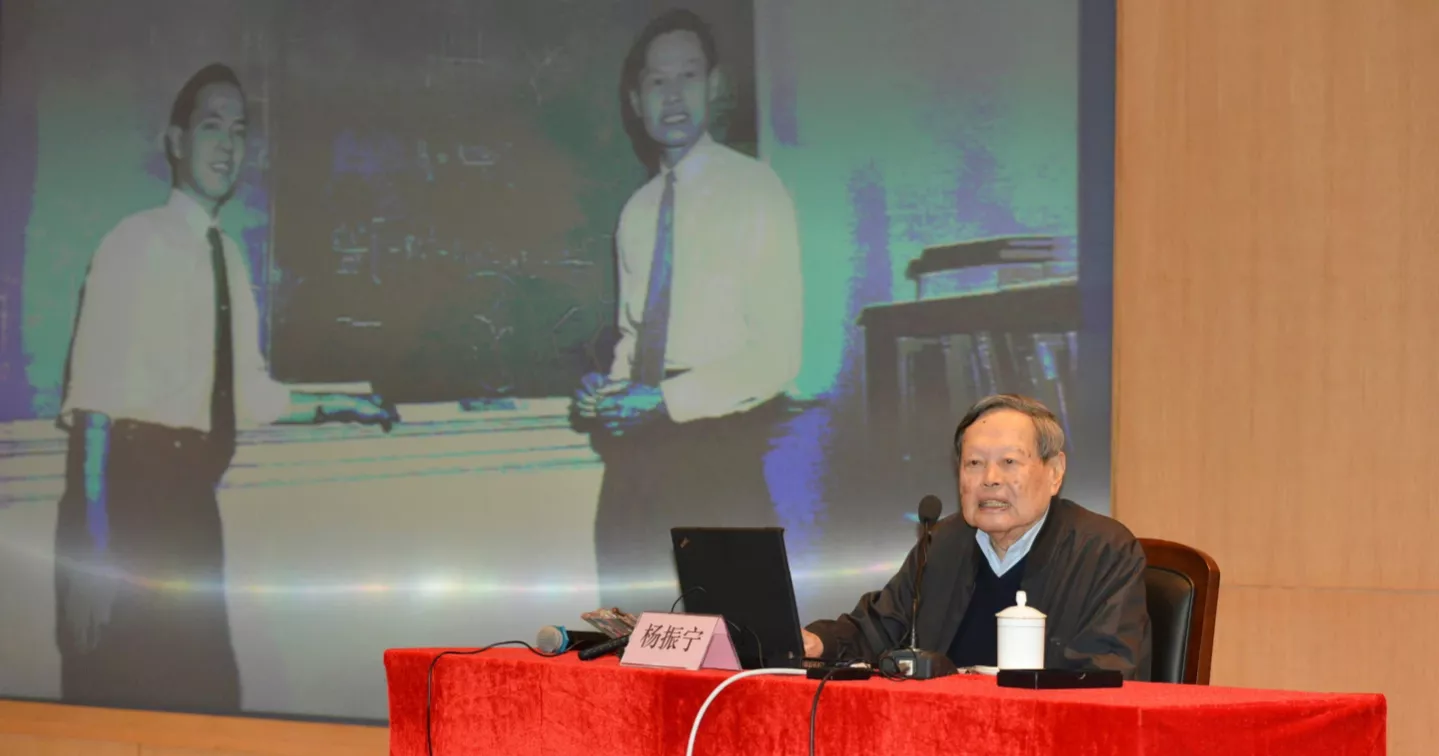
Chen Ning Yang, the Chinese Nobel Prize-winning physicist who transformed modern physics with groundbreaking discoveries, died in Beijing on Saturday at the age of 103.
Tsinghua University, where Yang both studied and later taught, confirmed his passing from illness but did not provide further details. The university hailed him as “one of the greatest physicists of the 20th century,” recognizing his lasting contributions to China’s scientific and educational progress.
Yang, along with fellow physicist Tsung-Dao Lee, won the 1957 Nobel Prize in Physics for challenging the long-held law of parity conservation in particle interactions — a discovery that reshaped the field of elementary particle physics. The two were the first Chinese-born scientists to receive the Nobel in physics.
In his Nobel banquet speech, Yang reflected on his dual identity, saying he was deeply proud of his Chinese roots while being equally devoted to modern science, “a part of human civilization of Western origin.”
Born in 1922 on the Tsinghua University campus, where his father taught mathematics, Yang earned both his bachelor’s and master’s degrees there before moving to the University of Chicago in 1946 for doctoral studies under renowned physicist Enrico Fermi. He later served as a professor at the Institute for Advanced Study in Princeton, where he co-developed the influential Yang–Mills theory with Robert Mills — a cornerstone of modern particle physics.
Yang became a Professor-at-large at the Chinese University of Hong Kong in 1986 and returned to Tsinghua in 1999 as a professor. He renounced his U.S. citizenship in 2015, saying he remained grateful to America for the opportunities it provided in his scientific career.
Yang is survived by three children, according to the Nobel Prize website.