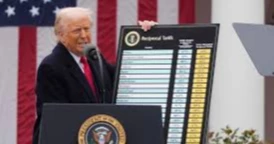
A US federal appeals court ruled on Friday that former President Donald Trump had no legal authority to impose widespread tariffs under emergency powers — a major legal setback for the former president. However, the court left the tariffs in effect for now, giving the administration until mid-October to appeal to the Supreme Court.
The U.S. Court of Appeals for the Federal Circuit upheld a lower court’s ruling that Trump overreached under the 1977 International Emergency Economic Powers Act (IEEPA) when he imposed tariffs on nearly all foreign imports.
"It seems unlikely Congress meant to grant the President unlimited authority to impose tariffs," the judges said in a 7-4 decision.
Despite the ruling, the tariffs remain active while the legal process continues. Trump vowed to challenge the decision, claiming it would “destroy the United States of America” if not overturned.
A White House spokesperson, Kush Desai, maintained that Trump acted legally and expressed confidence in ultimately winning the case.
Meanwhile, Jeffrey Schwab, a lawyer representing small businesses harmed by the tariffs, said the ruling confirms that the president cannot impose tariffs without limits, protecting U.S. companies and consumers from “uncertainty and harm.”
However, Jake Colvin, president of the National Foreign Trade Council, warned that businesses may not feel immediate relief and called on Congress to reclaim its constitutional role over trade policy.
Senator Ron Wyden (D-Ore.) said he would push for votes to repeal the tariffs whenever possible.
What the ruling means for Trump’s trade agenda
The decision complicates Trump’s efforts to reshape U.S. trade policy unilaterally. While other legal avenues exist for imposing import taxes, they come with greater limits and longer timelines.
Trump’s unpredictable tariff strategies have unsettled global markets, strained alliances, and raised concerns about inflation and economic slowdown. However, he has also used them to pressure countries like the EU and Japan into accepting trade terms favorable to the U.S. and to generate revenue to help offset his tax cuts.
Before the ruling, some legal experts, like Ashley Akers from law firm Holland & Knight, noted that tariffs were a core part of Trump’s trade negotiation strategy — one that could be weakened by the court’s decision.
A dissenting opinion from four judges argued that the 1977 law does not violate constitutional limits and does allow the president some authority to act in emergencies.
The Justice Department warned in recent court filings that overturning the tariffs could lead to billions in refund claims and a major hit to the federal budget. So far, the U.S. has collected $159 billion in tariff revenue, more than twice the amount collected in the previous year.
Attorney General Pam Bondi accused the court of interfering with the president’s foreign policy powers and also vowed to appeal.
What tariffs are involved?
The ruling focuses on two sets of Trump-imposed tariffs:
“Liberation Day” tariffs (April 2):
Trump imposed up to 50% tariffs on imports from countries with which the U.S. runs trade deficits, and a 10% baseline tariff on nearly all others. He justified them under a declared national emergency over the U.S. trade deficit.
“Trafficking tariffs” (Feb 1):
Tariffs placed on imports from Canada, Mexico, and China in response to a claimed national emergency involving the flow of illegal drugs and migrants into the U.S.
Critics argued that the longstanding U.S. trade deficit — ongoing for 49 years — does not constitute the kind of “extraordinary threat” required to invoke emergency powers under IEEPA.
The Court of International Trade had previously ruled in May that the Liberation Day tariffs exceeded Trump’s legal authority. It also rejected the trafficking tariffs, saying they did not directly address the stated emergencies.
What’s not affected?
The case does not challenge:
Tariffs on steel, aluminum, and autos imposed after a Commerce Department investigation cited national security risks.
China-specific tariffs under Section 301 of the 1974 Trade Act, which President Biden has kept in place.
What happens next?
If the Supreme Court takes up the case and overturns the tariffs, the U.S. could face massive refund demands from importers.
Trump may still try to impose tariffs under other legal tools, such as:
Section 122 of the 1974 Trade Act, which allows tariffs of up to 15% for 150 days on countries with big trade surpluses.
Section 301, which lets the president retaliate against unfair trade practices — the legal basis for his trade war with China.