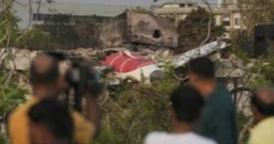
Rescue teams in Gujarat continued their operations for a third straight day following one of India’s deadliest aviation tragedies, where an Air India aircraft crashed, raising the confirmed death toll to at least 270, officials reported Saturday.
The London-bound Boeing 787 crashed into a hostel at a medical college in a residential area of Ahmedabad shortly after taking off on Thursday. The impact killed 241 passengers and crew on board and at least 29 people on the ground. Miraculously, one passenger survived.
Authorities said search crews discovered at least 25 additional bodies in the wreckage late Friday.
A small plane crashes into the terrace of a house in Germany, 2 people are dead
Dr. Dhaval Gameti from Ahmedabad’s Civil Hospital confirmed the arrival of 270 bodies at the facility. The sole survivor is still being treated but is recovering well and may be discharged soon.
“His condition is stable and he’s expected to go home soon,” Gameti noted on Saturday.
Due to the extent of the burns and injuries, most of the victims’ remains are unrecognizable, prompting hundreds of grieving relatives to submit DNA samples for identification.
Frustrations mounted on Saturday as families demanded faster results. Officials say DNA matching can take up to 72 hours, but efforts are underway to speed up the process.
“Where are my children? Have they been found?” cried Rafiq Abdullah, whose family members were aboard the plane. “The government isn’t giving us answers.”
Another grieving relative repeatedly urged hospital staff to release the body of a loved one so that funeral rites could be performed.
On Friday, investigators retrieved the aircraft’s flight data recorder—or black box—from a rooftop near the crash site, a crucial step in determining the cause of the accident.
India’s Aircraft Accident Investigation Bureau said it is working intensively to extract and analyze the data.
Mechanical engineer Paul Fromme of the U.K.-based Institution of Mechanical Engineers explained that the black box could shed light on the plane’s engine status, control settings, and cockpit conversations.
Jeff Guzzetti, an aviation safety expert and former U.S. crash investigator, said key insights might be available as early as next week, assuming the data recorder is intact. Investigators will likely examine factors such as wing flap positions, engine performance, potential cockpit alarms, and whether the crew accounted for fuel load, passenger weight, and the high temperature.
Guzzetti noted that incorrect data could lead to misconfigured wing flaps, potentially contributing to the crash.
The aircraft involved in Thursday’s disaster was a 12-year-old Boeing 787. While other Boeing models have faced safety concerns, this marks the first fatal crash involving a Dreamliner since its introduction 16 years ago. There are roughly 1,200 of the aircraft in operation globally.