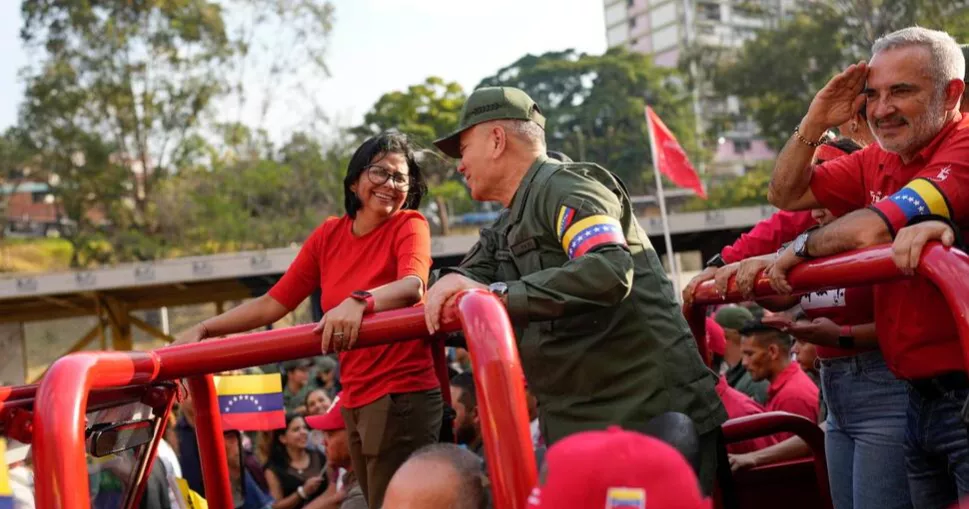
Delcy Rodríguez has assumed the role of interim president of Venezuela following the capture of President Nicolás Maduro by the United States in a nighttime military operation, amid growing uncertainty over the country’s political future.
Rodríguez, who has served as Maduro’s vice president since 2018, was next in the constitutional line of succession and has been a central figure in managing Venezuela’s oil-dependent economy and its powerful intelligence apparatus. On Saturday, Venezuela’s Supreme Court ordered her to take over as interim leader, a move that was swiftly backed by the military.
In a televised address, Rodríguez showed no sign of cooperating with the Trump administration, referring to the US government as “extremists” and insisting that Maduro remains Venezuela’s legitimate president. She described the US action as an “atrocity” and a violation of international law.
US President Donald Trump, however, offered mixed signals about Rodríguez. Speaking aboard Air Force One on Sunday night, he said she was “cooperating” and that he wanted full access to Venezuela’s oil facilities and infrastructure so they could be rebuilt. At the same time, he warned that she could face consequences “probably worse than Maduro” if she failed to work with Washington.
Earlier, Trump had said Secretary of State Marco Rubio had been in contact with Rodríguez and described her as someone the US could work with, unlike Maduro. Rubio later told US television networks that he did not view Rodríguez’s government as legitimate, arguing that Venezuela had not held free and fair elections.
Rodríguez, a 56-year-old lawyer educated in Britain and France, has long been a prominent defender of the socialist movement launched by the late Hugo Chávez. Along with her brother Jorge Rodríguez, head of the pro-Maduro National Assembly, she rose to prominence from a political legacy shaped by their father, a leftist leader who died in police custody in the 1970s.
Although she has avoided US criminal indictments that have targeted other senior Venezuelan officials, Rodríguez was sanctioned during Trump’s first term for actions Washington said undermined democracy. Over the years, she has held several senior posts, including foreign minister and petroleum minister, and played a key role in stabilizing the economy after years of crisis.
Analysts say Rodríguez has cultivated close ties with the military, which has long been a decisive force in Venezuelan politics, as well as with international oil industry figures wary of abrupt regime change.
It remains unclear how long she will remain in power. Venezuela’s constitution requires a presidential election within 30 days if a president is deemed permanently unable to serve. However, the Supreme Court ruled that Maduro’s absence is temporary, allowing the vice president to assume power for up to 90 days, extendable to six months with parliamentary approval. The court did not specify a time limit in its ruling, raising speculation that Rodríguez could seek to extend her hold on power as she navigates internal party divisions and external pressure from Washington.