
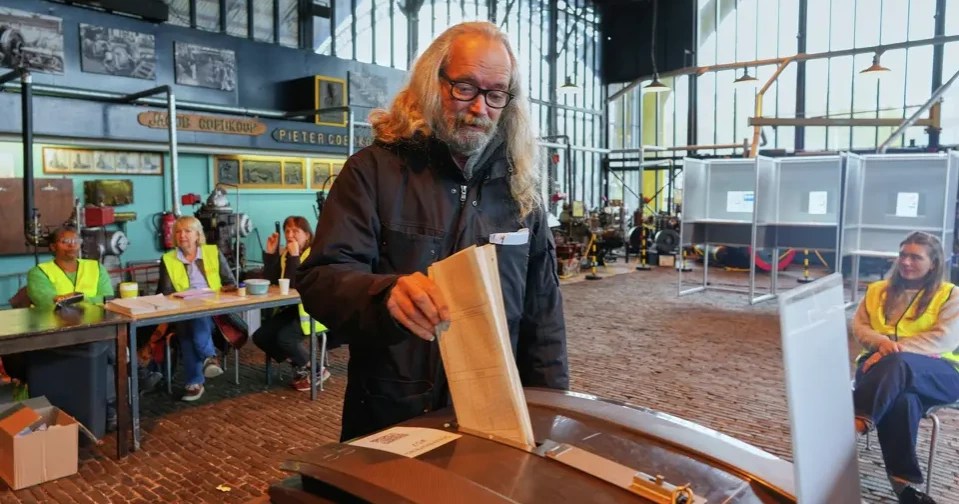
The Dutch general election ended in an unprecedented tie on Thursday, with far-right Party for Freedom and centrist D66 each winning 26 seats, according to nearly complete results reported by the Dutch news agency ANP.
The deadlock is expected to delay the formation of a new coalition government, which could take weeks or even months in the Netherlands’ fragmented political landscape. No previous Dutch election has seen two parties finish with an equal number of seats.
Globally, tight elections have often captured headlines. In the 2000 U.S. presidential race, George W. Bush narrowly defeated Democrat Al Gore by just 537 votes in Florida after weeks of recounts and a Supreme Court ruling. The controversy centered on outdated punch-card ballots with “hanging” and “dimpled” chads.
Earlier this year, Poland saw conservative Karol Nawrocki narrowly defeat Warsaw Mayor Rafał Trzaskowski with 50.89% to 49.11% of the votes in a runoff, highlighting the country’s political divisions along the NATO and EU eastern flank. While the Polish president holds veto and foreign policy powers, most governance rests with the prime minister.
Portugal’s 2024 general election also ended narrowly, with a center-right Social Democratic alliance winning by just two seats in the 230-member parliament. The hard-right Chega party surged from 12 to 50 seats, disrupting decades of alternating power between Social Democrats and Socialists, though the government lasted only a year.
Ireland’s 2020 election produced another tight finish, with Fianna Fáil, Sinn Féin, and Fine Gael securing 38, 37, and 35 seats respectively. Fianna Fáil and Fine Gael, historical rivals, eventually formed a coalition, excluding Sinn Féin despite its electoral breakthrough.
Germany’s 2005 parliamentary election saw Angela Merkel take office with a narrow margin after then-Chancellor Gerhard Schröder’s Social Democrats claimed half the cabinet seats.
In Greece, 1990 elections left Conservative leader Constantine Mitsotakis dependent on a single seat from the small Renewal Party to achieve a slim majority in the 300-seat parliament.
These examples underline the global impact of razor-thin electoral outcomes and the political uncertainty that often follows.