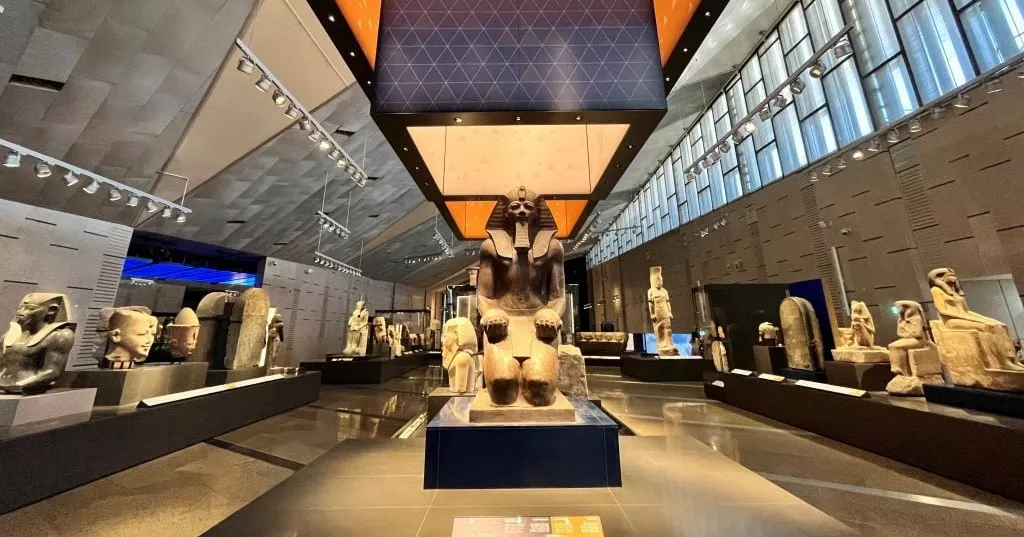
Egypt on Saturday inaugurated the long-awaited Grand Egyptian Museum (GEM) — the world’s largest museum dedicated to ancient Egyptian civilization — marking a milestone in both cultural preservation and efforts to revive the country’s tourism-driven economy.
Located near the Giza Pyramids on the outskirts of Cairo, the $1 billion museum has been two decades in the making. It houses more than 50,000 artifacts tracing Egypt’s rich history, from prehistoric times to the Roman era.
World leaders, including monarchs and heads of state, attended the inauguration, which the Egyptian presidency described as “an exceptional event in the history of human culture and civilization.” President Abdel-Fattah el-Sissi said the museum reflects the “genius of ancient Egyptians” and the “creativity of modern Egyptians,” serving as a new global cultural landmark.
The GEM features a striking triangular glass façade inspired by the nearby pyramids and includes 24,000 square meters of permanent exhibition space. A grand staircase lined with ancient statues leads visitors toward main galleries offering panoramic views of the Giza Plateau. A pedestrian bridge and electric vehicles will connect the museum to the pyramids.
Among the museum’s 12 main galleries, two are devoted to King Tutankhamun’s collection — over 5,000 artifacts displayed together for the first time since the tomb’s discovery by Howard Carter in 1922. Highlights include the boy pharaoh’s golden throne, funerary beds, chariots, and his iconic gold burial mask. Renowned archaeologist Zahi Hawass called the Tutankhamun exhibit the museum’s centerpiece, saying, “Everyone is waiting for this opening because of Tutankhamun.”
The facility’s completion comes after years of political upheaval and construction delays since work began in 2005. The Egyptian government also modernized surrounding areas, improving roads, constructing a metro station, and opening the nearby Sphinx International Airport to make access easier for tourists.
Authorities hope the museum will boost Egypt’s crucial tourism sector, which has struggled since the 2011 Arab Spring but has begun to recover. Egypt welcomed a record 15.7 million tourists in 2024, contributing about 8% of GDP, and aims to double that figure by 2032.
The Grand Egyptian Museum will open its doors to the public on Tuesday.