
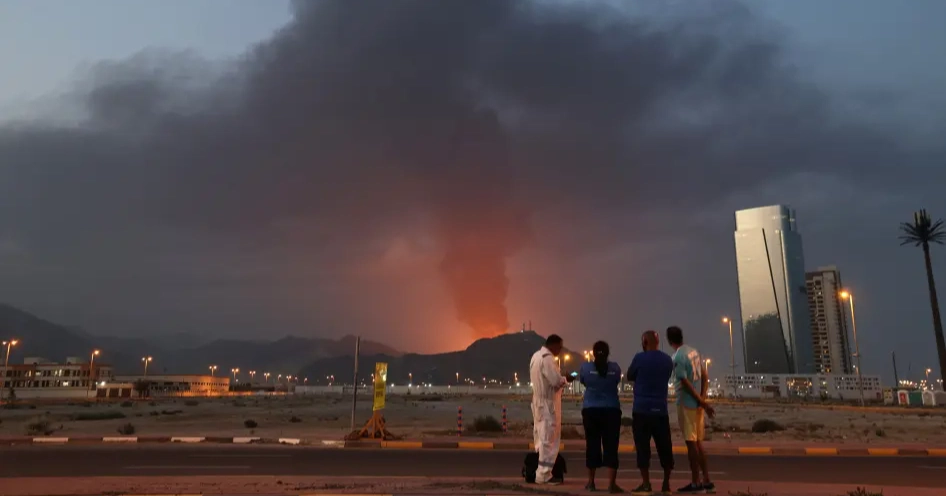
Migrant workers in Gulf Cooperation Council (GCC) countries are facing heightened threats to both their safety and economic rights due to the ongoing regional conflict, Human Rights Watch said on Wednesday.
These workers perform essential roles that keep Gulf economies running during the crisis, including delivering food and water, providing healthcare, and maintaining critical infrastructure.
Despite this, many are struggling to meet daily expenses because of income loss, rising costs, and limited access to social services or security.
“Millions of migrant workers employed across the Gulf countries are navigating threats to their physical safety and job security amid the conflict,” said Michael Page, deputy Middle East and North Africa director at Human Rights Watch.
“The conflict has brought new risks to migrant workers while also exposing the gaps in labor and other rights, including those enabled by the kafala (sponsorship) system.”
Human Rights Watch urged Gulf states to implement emergency measures to offset income losses and compensate workers where necessary. The crisis also underscores the need for long-term reforms, including ensuring living wages, respect for contracts, and access to social security benefits.
Authorities should also support workers who wish to return home by providing airfare assistance or coordinating with origin-country governments and airlines to offer affordable travel.
In March 2026, Human Rights Watch interviewed 38 migrant workers from India, Nepal, and Bangladesh in Bahrain, Kuwait, Oman, Qatar, Saudi Arabia, and the UAE. Workers included drivers, delivery staff, security guards, chefs, and cleaners—millions of whom perform essential jobs that keep hospitals, markets, and transportation running despite risks. HRW also spoke with families of Bangladeshis killed in Bahrain, UAE, and Saudi Arabia.
“My job is at a hospital, so the work has not stopped,” said a worker at a Qatar hospital. “Sometimes explosions come at night, sometimes during the day. Many thoughts keep running through my mind about what might happen … I have left my child back home.”
As of March 25, conflict-related deaths in Gulf countries included migrant workers, such as a Pakistani driver, a Nepali security guard, and a Bangladeshi water-tanker driver, according to media and government reports. Others have been injured.
Saleh Ahmed, a Bangladeshi, was killed in Ajman, UAE, when debris from an attack pierced his cab, according to family members. Another Bangladeshi, A.M. Tarek, was struck on the head by shrapnel while descending from a ship’s roof in Bahrain’s Hidd industrial area, dying instantly after completing his night shift.
HRW has long called for mandatory life insurance policies to ensure families of deceased workers receive compensation regardless of cause, time, or place of death.
One injured worker said, “It feels like God saved me.… Otherwise, I would have died like a stray dog.… I feel angry because innocent workers like us are suffering for no reason.” Those who were injured reported receiving adequate medical care.
While workers acknowledged the effectiveness of Gulf air defense and warning systems, they expressed ongoing fears about security. A UAE-based migrant community leader said: “On one hand, migrants are working in fear. On the other, there is constant anxiety about losing jobs.”
“I’m afraid every time I go out to work,” said a Qatar-based delivery worker. “There’s no way of knowing where the next missile will land. But I go anyway.… People like me, we are thinking about one thing and one thing only: how to make the next 10 riyals.” Alerts from government or company WhatsApp groups help him reroute or go home.
Although he can log out of the app assigning delivery orders if unsafe, he must meet his contractual obligations with the labor supplier, working 12 hours a day and completing at least 10 orders.
“This is a commission-based job,” said a Kuwait-based taxi driver. “We don’t have salary. The number of rides has dropped.” His earnings have fallen by more than half, insufficient to cover living and work expenses, including fuel, car maintenance, housing, and payments to the taxi owner.
Migrant workers in UAE, Kuwait, Bahrain, and Qatar reported soaring food prices. While larger markets face government oversight, low-paid workers often rely on smaller shops that remain unregulated. A Kuwait-based worker said: “What we used to spend for two months of food supplies won’t even last for one month now.” Prices of vegetables and other items have doubled or tripled.
Gulf laws require employers to provide meals or allowances. For example, Qatari law mandates a minimum of 300 QAR (about US$82) per month if food is not provided, a rate unchanged since 2021. However, some migrants, including undocumented workers and those on “free” (azad) visas, must cover their own food costs.
A Bahrain-based unemployed Bangladeshi on a “free visa” said: “Sometimes I do not even have enough food to eat. Even if it is risky, I have to go out and look for work just to arrange food … but I cannot find any work. So far, I have already brought about 20,000 taka [about $163] from home to survive. I do not know how long this can continue or how long this conflict will last.”
HRW geolocated a video showing crowds in Bahrain waiting for day-labor jobs with construction contractors.
A Kuwait-based cab driver on a “free visa” said: “My income has fallen to one-fifth of what it was and does not cover basic costs … Today, I drove for four hours and did not earn anything.”
Human Rights Watch urged Gulf states to assess the crisis’s economic impact on migrant workers and implement emergency measures to secure their economic, social, and cultural rights, including food and housing.
Some workers face reduced work, pay cuts, or compulsory unpaid leave despite two-year contracts. UAE hospitality staff reported hotels reducing staff due to low occupancy, putting employees on unpaid leave or terminating contracts.
One UAE-based chef said: “We are down to 3-4 staff from 25-30. Workers on unpaid leave until further notice unable to return home are provided company accommodation, but they must pay for their own food.”
An Abu Dhabi-based Nepali chef said: “To lose a job after taking recruitment loans to come here is sad. People pay 300,000-400,000 Nepali Rupees [about $2,000-2,686] for these jobs.” HRW noted that most Gulf migrants pay high recruitment fees financed via informal loans.
Even workers who received pay at the crisis onset expressed concern. A Bahrain-based supply manager said three clients asked him to cut salaries by half for over 400 workers.
A Kuwait-based worker said restaurant staff face reduced hours and pay cuts: “The airport is closed so going home is not an option. The option of traveling via Saudi Arabia is not affordable as ticket prices have skyrocketed.”
Under international law, governments must ensure all workers receive fair wages and social security to maintain an adequate standard of living, including during crises. Gulf states should also provide crisis information in workers’ native languages.
Employers must uphold contracts during the conflict, while businesses in sectors like tourism should implement contingency plans to protect workers rather than shift the burden. Migrants unable to work should still receive contractual wages, and governments should support small and medium enterprises to prevent cost transfers to low-paid workers.
“Governments and employers should take concrete steps to protect workers caught in the crossfire thousands of miles from home and who despite significant risks are doing essential jobs across the Gulf,” Page said.