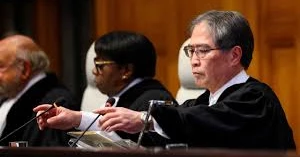
Hearings opened on Monday at the United Nations’ highest judicial body to determine whether Myanmar is responsible for committing genocide against the Rohingya ethnic minority.
The case was brought before the International Court of Justice (ICJ) in 2019 by The Gambia, which argues that Myanmar’s military campaign against the Rohingya in 2017 breached the 1948 Genocide Convention. Myanmar, now under military rule, has consistently rejected the allegations.
In his opening remarks, Gambian Justice Minister Dawda Jallow said his country pursued the case out of a “sense of responsibility,” shaped by its own history under military rule. Addressing judges in a packed courtroom in The Hague, he said the international community must speak out against oppression and crimes targeting individuals and groups wherever they occur.
Jallow also drew attention to around a dozen Rohingya survivors who travelled from refugee camps to attend the proceedings. At his request, they silently stood before the judges.
Myanmar launched its security operation in Rakhine State following attacks by a Rohingya insurgent group in 2017. The military has been accused of widespread killings, sexual violence and burning villages, forcing more than 700,000 Rohingya to flee to neighbouring Bangladesh.
Today, an estimated 1.2 million Rohingya live in overcrowded refugee camps, where insecurity is widespread and armed groups reportedly recruit children. Aid cuts in recent years have worsened conditions, shutting down schools and leaving many children malnourished.
“We lack even the most basic things that human beings need,” said Yousuf Ali, a Rohingya refugee who travelled from Bangladesh to The Hague to witness the hearings.
Myanmar was initially represented at the ICJ by former leader and Nobel Peace Prize laureate Aung San Suu Kyi, who in 2019 denied that genocide had occurred, arguing the mass displacement was a consequence of counterinsurgency operations. She is now imprisoned following the military’s seizure of power, convicted on charges her supporters say are politically motivated.
Myanmar had challenged the court’s jurisdiction, claiming The Gambia had no standing to file the case as it was not directly affected by the conflict. However, in 2022, the ICJ dismissed that objection, noting that both countries are parties to the Genocide Convention, and allowed the case to proceed.
That ruling later paved the way for South Africa to file a separate genocide case against Israel, an allegation Israel denies, accusing Pretoria of shielding Hamas.
Legal experts say the outcome of the Myanmar case could have broader implications. Juliette McIntyre, an international law specialist at the University of South Australia, said the legal threshold for proving genocide is high but could be interpreted more broadly by the judges.
A ruling that genocide occurred would also strengthen ongoing proceedings at the International Criminal Court. In 2024, the ICC prosecutor sought an arrest warrant for Myanmar’s military chief Senior General Min Aung Hlaing over alleged crimes against the Rohingya, a request that remains under consideration.