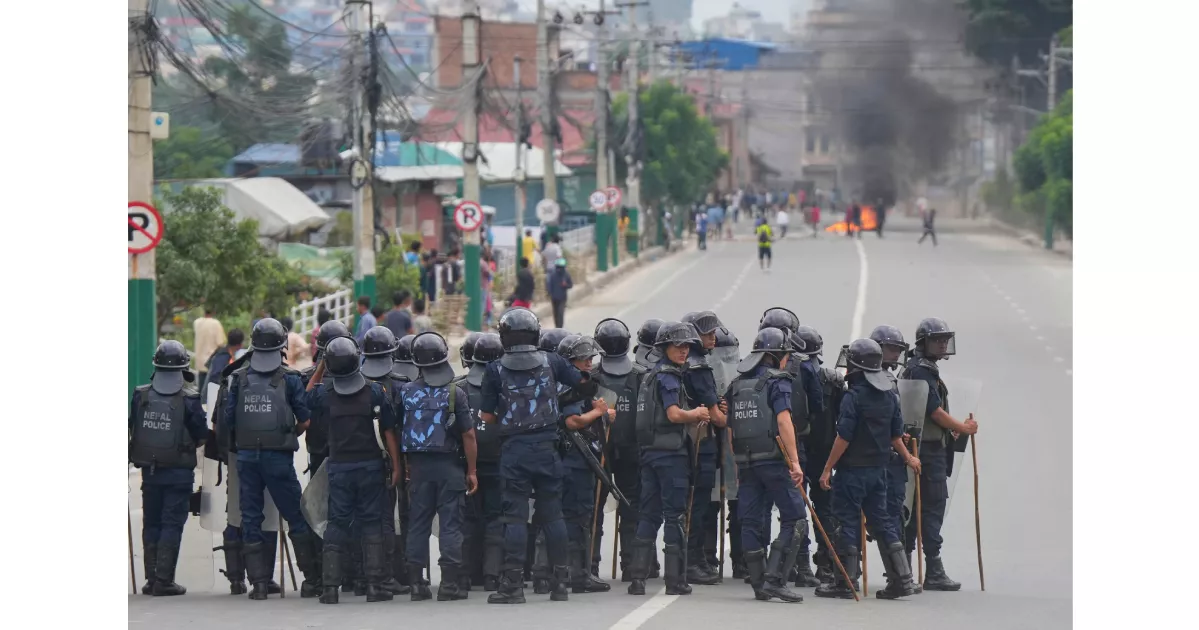
Widespread protests erupted across Nepal, with demonstrators setting fire to the residences of senior political leaders in response to a controversial social media ban that had been lifted early Tuesday, following a deadly day of anti-government unrest.
Videos circulating online and reports from local media showed protestors targeting the homes of key political figures in Kathmandu and nearby areas. In response, authorities imposed a curfew in the capital and other cities, while schools in Kathmandu were closed.
Among the properties torched were the homes of Sher Bahadur Deuba, leader of the Nepali Congress; President Ram Chandra Poudel; Home Minister Ramesh Lekhak; and Maoist leader Pushpa Kamal Dahal. A private school owned by Arzu Deuba Rana—Deuba’s wife and current Foreign Minister—was also attacked.
What began as outrage over the government’s ban on social media platforms escalated into a broader expression of public anger over corruption and political dysfunction.
“I’m here because our country is drowning in corruption,” said student protester Bishnu Thapa Chetri. “There’s no future here for young people like me.”
He added that the demonstrators wanted “peace and an end to corruption,” so that people could live and work in Nepal without needing to leave.
Despite the indefinite curfew, demonstrations continued on Tuesday. Protesters chanted slogans like “Punish the murderers in government” and “Stop killing children,” while police broadcast warnings for crowds to disperse.
Public outrage is increasingly directed at Prime Minister Khadga Prasad Oli, whose government has grown unpopular amid accusations of authoritarianism.
“We’re out here because our friends are being killed,” said protester Narayan Acharya. “We want justice and an end to Oli’s regime.”
Durganah Dahal, another protester, accused the government of deliberately targeting students with lethal force. “They killed so many hopeful young people yesterday—how can we stay silent? We’ll protest until this government is gone.”
The government had blocked access to major social media platforms like Facebook, YouTube, and X (formerly Twitter) last week, after they failed to register with local authorities under a new oversight law. Monday’s protest—largely driven by members of Gen Z—drew tens of thousands to the streets, culminating in violent clashes around the Parliament building where police opened fire, killing 19.
“End the social media ban. Fight corruption, not free speech,” protesters shouted, waving national flags.
Nepal’s main trauma hospital, the National Trauma Center, treated many of the injured. “Several have serious wounds, mostly gunshots to the head and chest,” said Dr. Badri Risa. Families gathered in distress while others lined up to donate blood.
Prime Minister Oli has announced a 15-day investigation into the incident and promised compensation for the victims’ families and free medical care for the injured.
Home Minister Ramesh Lekhak resigned during an emergency cabinet meeting late Monday.
The violent unrest comes amid the government’s broader effort to regulate online platforms under new legislation criticized by rights groups as repressive. The proposed law demands that tech companies establish local contact offices and register officially, a move seen by many as a crackdown on free expression.
Roughly two dozen platforms are affected by the rule. While TikTok, Viber, and three others complied, major companies like Google (YouTube), Meta (Facebook, Instagram, WhatsApp), and Elon Musk’s X have not responded publicly.
Nepal had previously banned TikTok in 2023 over concerns it was spreading harmful content, but the ban was later lifted after the platform agreed to follow national laws, including an earlier prohibition on pornography.