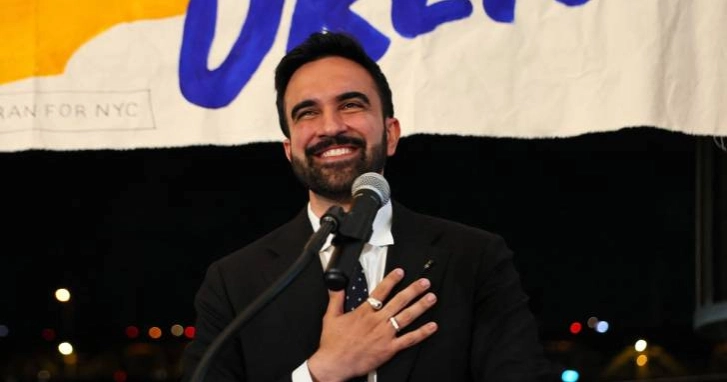
Zohran Mamdani, a 33-year-old Muslim of South Asian descent, shocked the political establishment by defeating former New York Governor Andrew Cuomo in Tuesday’s Democratic mayoral primary, positioning himself to become the party’s candidate for the top job in America’s largest city.
If Mamdani, a state assemblyman, wins the November election, he would be New York City’s first Muslim and first mayor of Indian origin.
As the votes came in, Mamdani quoted Nelson Mandela in a social media post early Wednesday, saying: “It always seems impossible until it’s done. My friends, it is done. And you are the ones who did it. I am honoured to be your Democratic nominee for the Mayor of New York City.”
Cuomo, who resigned as governor in 2021 following sexual harassment allegations, publicly conceded after calling Mamdani to congratulate him. “Tonight was Assemblyman Mamdani’s night, and he put together a great campaign,” Cuomo said at an event in Manhattan. “And he touched young people, and inspired them, and moved them, and got them to come out and vote. And he really ran a highly impactful campaign.”
Political commentators see Mamdani’s likely win as a signal of broader shifts within the Democratic Party, still reeling from its defeat in the 2024 presidential and Congressional elections.
How did Mamdani pull off the surprise win?
In the first-choice tally of New York City’s ranked-choice Democratic mayoral primary on June 24, Mamdani secured 43.5 percent of the vote—about 432,000 votes—while Cuomo trailed with 36.4 percent, or roughly 361,800 votes. Progressive Comptroller Brad Lander finished third with 11.3 percent, with the rest of the votes split among minor candidates.
As no candidate crossed the 50 percent mark initially, the ranked-choice system came into effect, eliminating lower-ranked contenders and redistributing their supporters’ next preferences. Reports suggest Mamdani benefited heavily from Lander’s progressive supporters, propelling him toward an eventual majority. Though final results may take days, Mamdani’s victory appears inevitable, reinforced by Cuomo’s concession.
Zohran Mamdani stuns Cuomo, poised to be NYC’s first Muslim mayor
Was Mamdani’s victory anticipated?
Not according to polls. In the run-up to the primary, major surveys consistently showed Cuomo in the lead, although Mamdani’s numbers were rising.
A Marist Poll conducted on June 18 placed Cuomo ahead with 38 percent of first-choice votes, while Mamdani trailed at 27 percent. That poll also projected Cuomo to ultimately win 55 percent in the ranked-choice rounds.
Earlier, a May poll by Emerson College found Cuomo at 37 percent and Mamdani at just 17 percent. In April, a Siena/AARP poll showed Cuomo with 39 percent support to Mamdani’s 15 percent.
Cuomo’s deep-rooted name recognition, boosted by his father Mario Cuomo’s legacy as a former state governor, coupled with a well-funded campaign, seemed to make him the frontrunner.
However, Mamdani’s grassroots strategy, powered by volunteers, small-dollar donors, and high turnout from young voters, proved decisive—especially in working-class areas across Queens, Brooklyn, and parts of Manhattan.
Despite critics, including Cuomo, portraying Mamdani as inexperienced and ill-equipped to handle the city’s complex governance, voters evidently disagreed.
Who is Zohran Mamdani?
Mamdani, a Democratic Socialist, was born in Kampala, Uganda, and moved to New York at age seven. He is the son of renowned Ugandan scholar Mahmood Mamdani and acclaimed Indian filmmaker Mira Nair.
He holds a degree in Africana Studies from Bowdoin College in Maine. Before entering politics, Mamdani worked as a housing counselor, helping low-income New Yorkers avoid evictions.
He was elected to the State Assembly in 2020, representing Astoria, Queens.
Earlier this year, Mamdani married Syrian artist Rama Duwaji, whose work has been featured in The New Yorker, The Washington Post, and VICE.
What is Mamdani’s position on Gaza?
Mamdani is one of the most outspoken critics of Israel’s war in Gaza among American elected officials. On October 31, 2024, he posted on X: “I will always be clear in my language and based in facts: Israel is committing a genocide.”
He is also a strong supporter of the Boycott, Divestment, and Sanctions (BDS) movement, which he links to “the core of my politics, which is non-violence.”
One of the most talked-about moments of his campaign came in December 2024 during an interview with Mehdi Hasan, where Mamdani declared: “As mayor, I would have Netanyahu arrested if he came to New York!”
“This is a city [where] our values are in line with international law. It’s time that our actions are also,” he added.
Mamdani has faced criticism for his refusal to distance himself from the slogan “Globalize the Intifada,” which some Jewish leaders and conservatives have labeled anti-Semitic.
In a June 2025 podcast appearance on The Bulwark, Mamdani responded: “As a Muslim man who grew up post 9/11, I’m all too familiar (with) the way in which Arabic words can be twisted, can be distorted, can be used to justify any kind of meaning.” He stressed the slogan is about global solidarity with oppressed peoples, not inciting violence.
Cuomo’s campaign also targeted Mamdani’s Muslim identity and his pro-Palestinian stance, accusing him of anti-Semitism. New York hosts the world’s largest Jewish community outside of Israel.
Addressing Islamophobic threats he received, Mamdani stated: “There is no room for anti-Semitism in this city or country.” He has repeatedly clarified that his criticisms are aimed at government policies, not at Jewish people.
Trump says US-Iran talks expected next week as ceasefire holds
His campaign was fuelled by more than 22,000 volunteers and endorsements from progressives such as Bernie Sanders, Alexandria Ocasio-Cortez, and the Working Families Party.
What are Mamdani’s key proposals?
Mamdani’s platform focuses on bold, progressive reforms aimed at wealth redistribution and public service expansion.
Notable pledges include making all city buses free by 2027, citing successful fare-free transit pilots that improved ridership and safety.
On housing, he has vowed to freeze rents on stabilized apartments, roll back rent hikes on city-owned properties, and create a Social Housing Development Agency to provide permanently affordable, publicly-owned homes.
Mamdani also wants to establish municipally-run grocery stores in each borough to improve access to affordable food in underserved communities. His education plans include expanding free meal programs to city colleges and offering universal childcare and early learning programs.
To fund these initiatives, he proposes increasing the corporate tax rate from 7.25 percent to 11.5 percent and introducing a 2 percent surcharge on individuals earning over $1 million annually, which his campaign estimates could raise $9.4 billion per year.
On public safety, Mamdani advocates reallocating resources from the NYPD to a new Department of Community Safety, comprising mental health experts, crisis responders, and outreach teams.
What’s next — is Mamdani set to be mayor?
The general election is scheduled for November 4. Mamdani will face Republican Curtis Sliwa, who lost the 2021 mayoral race by a wide margin.
Given New York’s strong Democratic majority—where Democrats outnumber Republicans by more than six to one—Mamdani is widely expected to secure victory and become the city’s next mayor.
The last Republican to win the mayor’s office was Michael Bloomberg in 2001, who later became an Independent during his second term.
Source: With inputs from Al Jazeera