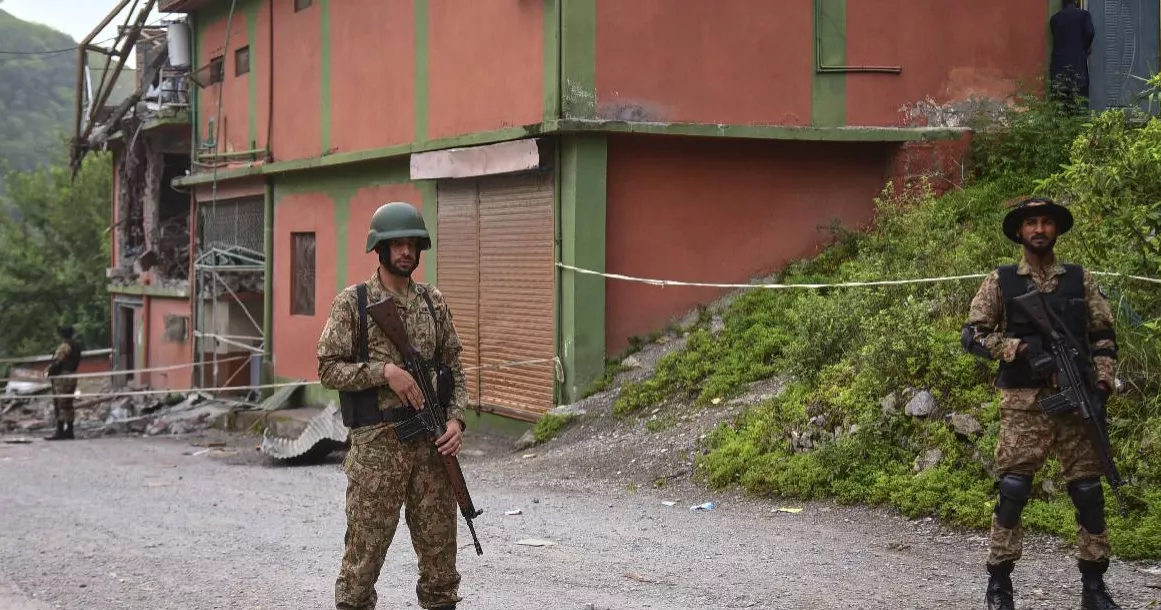
Pakistan has claimed it shot down several Indian fighter jets as India launched missile strikes on Pakistan early Wednesday in retaliation for the deadly attack on Indian tourists last month.
Pakistan, denouncing the action as an act of war, reported more than two dozen deaths, including children.
According to India’s Defense Ministry, the strikes targeted nine sites believed to be used to plan attacks on Indian soil.
Pakistan's military said the missiles struck six locations in Pakistan-administered Kashmir and Punjab province.
Pakistan also claimed it shot down multiple Indian fighter jets, with three reportedly crashing into Indian-controlled territory amid intense cross-border fire.
Indian authorities said Pakistani shelling in the region killed at least seven civilians, according to police and medical sources.
The missile attacks mark a sharp escalation in tensions between the nuclear-armed neighbors, already strained following an April massacre in India-controlled Kashmir, where gunmen killed 26 people—mostly Indian Hindu tourists—some in front of their spouses. India blamed the assault on a group named Kashmir Resistance, allegedly linked to the banned Pakistani outfit Lashkar-e-Taiba. Pakistan has denied any involvement.
The two countries, which have fought two of their three wars over the disputed Kashmir region, had already severed diplomatic ties and closed borders following the massacre. India also suspended a key water-sharing agreement.
Pakistani Prime Minister Shehbaz Sharif strongly condemned the missile strikes, calling them an act of war.
“Pakistan has every right to give a robust response to this act of war imposed by India, and a strong response is indeed being given,” Sharif said.
It remained unclear whether the reported downing of jets constituted Pakistan’s response or if further retaliation was planned.
South Asia expert Michael Kugelman noted the severity of India’s strikes, describing them as among the most forceful in years. He warned of a likely strong Pakistani response.
“These are two strong militaries that, even with nuclear weapons as a deterrent, are not afraid to deploy sizeable levels of conventional military force against each other,” Kugelman said. “The escalation risks are real. And they could well increase, and quickly.”
U.N. Secretary-General Antonio Guterres urged both nations to show restraint, warning that the world could not afford a military conflict between the two countries. China, a major investor in Pakistan with its own border disputes with India, also called for calm.
Pakistan’s National Security Committee convened Wednesday morning, while Indian Prime Minister Narendra Modi delayed an upcoming diplomatic trip and held a special meeting with his Cabinet Committee on Security.
India’s Home Ministry announced civil defense drills in several states to prepare for possible hostile attacks—an unusual step during peacetime.
Casualties and Damage in Pakistan
Pakistani military spokesperson Lt. Gen. Ahmed Sharif said the strikes killed at least 26 people, including women and children, and injured 38 more. Additional cross-border fire later in the day reportedly left five more people dead.
In Muzaffarabad, a resident described widespread panic after explosions destroyed homes and cut power. “We were afraid the next missile might hit our house,” said Mohammad Ashraf, a local resident.
One of the missiles reportedly hit infrastructure at a dam in Pakistan-administered Kashmir, which Sharif said violated international norms.
Two locations previously associated with banned militant groups were also struck, according to Pakistani officials. A missile hit Subhan Mosque in Bahawalpur, killing 13 people, near a seminary that once served as the main office of the now-banned Jaish-e-Mohammed group.
Another strike damaged a mosque in Muridke, near a complex that once housed Lashkar-e-Taiba’s headquarters before the group was banned in 2013.
India’s Defense Ministry described the operation as “focused, measured and non-escalatory,” stating that “no Pakistan military facilities have been targeted” and emphasizing India's “considerable restraint.”
Indian leaders across the political spectrum praised the operation, which was code-named “Sindoor,” a symbolic reference to the women whose husbands were killed in the Kashmir attack.
“Victory to Mother India,” Defense Minister Rajnath Singh wrote on X.