Iran launched missile and drone attacks on Israel early Saturday, killing at least three and injuring dozens, in retaliation for devastating Israeli strikes on Iranian nuclear facilities and military personnel.
Israeli forces used warplanes and drones—some reportedly smuggled into Iran in advance—to target strategic sites and eliminate top military leaders and scientists. According to Iran’s U.N. ambassador, the strikes left 78 dead and over 320 injured.
Israel justified its actions by claiming it was acting to prevent Iran from nearing nuclear weapons capability, despite assessments from experts and the U.S. suggesting Tehran wasn’t actively pursuing a bomb at the time.
Iran’s counterattacks lit up skies over Jerusalem and Tel Aviv as drones and ballistic missiles rained down, prompting the Israeli military to urge civilians—already distressed by months of war—to take shelter.
Nuclear Talks in Jeopardy
The Israeli strikes cast serious doubt on upcoming nuclear negotiations between the U.S. and Iran, planned for Sunday in Oman. Iran’s Foreign Ministry declared the talks “meaningless” in light of the Israeli assault.
Spokesman Esmail Baghaei accused Israel of crossing Iran’s red lines and called the attack a “criminal act.” However, he did not confirm whether the talks would be canceled outright.
Iranian Missiles Hit Israeli Cities
In a recorded message, Supreme Leader Ayatollah Ali Khamenei vowed that Israel would not “escape safely” from the consequences of its actions.
Iran’s missile barrage continued into Saturday, with footage on Iranian state TV showing people celebrating the strikes. The Israeli military intercepted some drones near the Dead Sea, but others hit civilian areas.
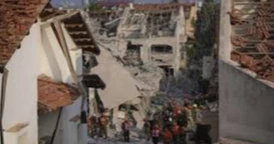
Seven people were treated at a Tel Aviv hospital, one fatally. Two more died and 19 were injured in Rishon Lezion when a missile struck a residential area. Multiple homes were severely damaged.
Explosions were heard in central Tehran as Iran’s air defenses responded to incoming threats. State media reported a fire at Mehrabad Airport, and a video showed smoke rising from the area.
The Israeli military confirmed hitting numerous targets around Tehran, including air defense systems.
In Tel Aviv and nearby Ramat Gan, buildings were damaged and residents injured, with one woman critically hurt. Burned cars and shattered homes bore witness to the attacks.
The U.S. was also involved in the defense, using ground-based systems to intercept Iranian projectiles, according to an unnamed official.
Fears of Escalating Conflict
The exchange of fire between Israel and Iran has heightened fears of a full-scale war, intensifying tensions across an already volatile region.
Many neighboring countries condemned Israel’s offensive, while international leaders appealed for both sides to de-escalate.
Although Israel has long threatened military action against Iran’s nuclear program, previous U.S. administrations worked to avoid such a conflict. But the fallout from Hamas’ October 7, 2023, attack and Donald Trump’s reelection created conditions that allowed Israel to move forward.
Prime Minister Benjamin Netanyahu said the U.S. was notified ahead of the strikes.
Major Nuclear Facilities Targeted
Israel hit several critical nuclear facilities, including the above-ground section of Iran’s Natanz enrichment site, where black smoke was seen rising. Another strike hit near the Fordo facility. A third location, a nuclear research center in Isfahan, was also targeted, with Iran confirming the damage.
U.N. nuclear chief Rafael Grossi reported that although the underground centrifuge complex at Natanz was intact, the strike destroyed surface structures and power loss may have harmed internal systems.
Netanyahu said the operation had been planned months earlier but was delayed.
Israeli intelligence reportedly deployed explosive drones and advanced weapons inside Iran before the attack to neutralize air defenses, according to sources speaking anonymously.
Israel has been steadily degrading Iranian air defenses over the past year, including strikes in April and October 2024, giving it increased freedom to operate in Iranian airspace. Officials indicated the campaign could continue for up to two weeks, although no fixed timeline was announced.
Among those killed in the Israeli strikes were key Iranian military leaders, including Chief of Staff Gen. Mohammad Bagheri, Revolutionary Guard head Gen. Hossein Salami, and missile program chief Gen. Amir Ali Hajizadeh. Two top deputies—responsible for intelligence and operations—were also confirmed dead.
On Friday, former U.S. President Trump urged Iran via Truth Social to negotiate a nuclear deal with Washington, warning that Israel’s strikes “will only get worse.”
“Iran must make a deal, before there is nothing left,” he posted.