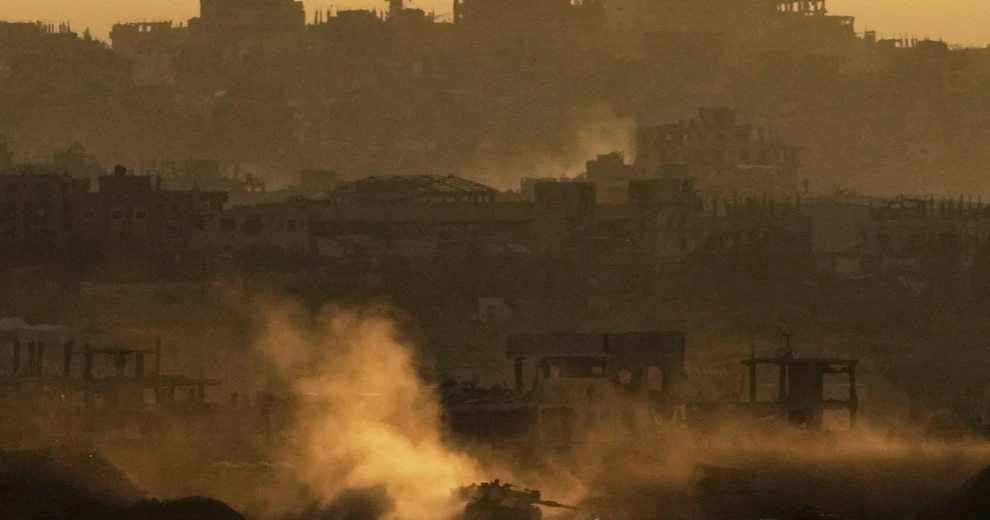
Israeli officials said Monday that the government has approved a plan to seize control of the entire Gaza Strip and maintain a presence there for an unspecified period, a decision that could significantly intensify the ongoing conflict and spark global condemnation.
The decision came after a pre-dawn vote by Israeli Cabinet ministers, following an announcement by the military chief that tens of thousands of reservists were being called up.
According to the officials, the objective of the plan is to achieve Israel's military goals — primarily the defeat of Hamas and the liberation of hostages held in Gaza. The operation is expected to displace hundreds of thousands of Palestinians toward southern Gaza, worsening an already critical humanitarian situation.
Since the March breakdown of a temporary truce with Hamas, Israel has launched relentless airstrikes, killing hundreds and taking control of about half of the Gaza Strip. Prior to the truce’s collapse, Israel had already stopped the flow of humanitarian supplies, including essentials like food, water, and fuel — triggering what many consider the worst humanitarian emergency since the conflict began nearly 19 months ago. The aid blockade has led to widespread hunger and increasing lawlessness.
Israel to expand military campaign in Gaza, says official
The plan includes military occupation and sustained control over territory, the officials said. A key part of the strategy is to prevent Hamas from distributing humanitarian aid, which Israel claims helps strengthen the group’s grip on the region. According to Israeli officials, Hamas has diverted aid to support its military efforts, and the new plan involves intensified attacks on Hamas positions.
Officials also revealed that Israel has engaged in discussions with other countries regarding a proposal tied to former U.S. President Donald Trump’s idea of relocating Gaza’s population — something Israel describes as “voluntary emigration” but which has drawn strong criticism from both European and Arab nations.
One of the sources said the plan would roll out in phases. Both requested anonymity due to the sensitive nature of the military strategy.
Israel has been steadily increasing pressure on Hamas in hopes of making the group more flexible in ceasefire negotiations, but diplomatic efforts have stalled. Hamas remains firm in its conditions, and Israel insists it will not end the war until Hamas is completely dismantled.
A central feature of the new plan is preventing Hamas from managing humanitarian aid. While specifics remain unclear, one official mentioned that Cabinet ministers approved a new system for aid distribution. A leaked memo obtained by the Associated Press suggests Israel has informed the U.N. that it intends to use private security firms to distribute aid within Gaza — a plan the U.N. has rejected, citing violations of its core humanitarian principles.
The memo, shared with aid organizations on Sunday, outlines a meeting between Israel’s defense liaison body COGAT and U.N. representatives. Under this approach, aid would enter through the Kerem Shalom crossing, with up to 60 trucks allowed daily. Aid parcels of about 20 kilograms would be handed out directly to individuals at distribution centers operated by private contractors. The system also includes facial recognition and SMS alerts to manage aid pickup.
The United Nations has criticized the strategy, warning that it may exclude large portions of the population — especially the most vulnerable — from receiving aid. The U.N. said the system seems intended to use access to essential supplies as leverage in Israel’s broader military campaign.
While the U.S. has expressed support for the plan, it remains unclear who will fund the private security operations and aid logistics. Neither COGAT nor the U.S. Embassy in Jerusalem offered immediate comment.
Earlier reports obtained by the AP show that humanitarian organizations fear the new distribution system could lead to the long-term displacement of Palestinians and result in what they describe as "de facto internment conditions."
The conflict began after a deadly Hamas-led attack on southern Israel, which left 1,200 people dead and about 250 taken hostage. Israel claims 59 hostages are still held in Gaza, though roughly 35 are believed to have died.
In response, Israel’s military campaign has killed over 52,000 people in Gaza — many of them civilians, including women and children — according to Palestinian health authorities. The conflict has forced more than 90% of Gaza’s population to flee their homes, often multiple times, leaving much of the region in ruins.
Israel previously occupied Gaza after the 1967 war but withdrew in 2005. Hamas took control of the area in 2007 and has governed it since.