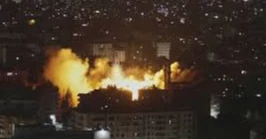
The Israeli military carried out airstrikes in the southern suburbs of Beirut on Thursday, claiming the targets were underground facilities used by Hezbollah for drone manufacturing. The attack came on the eve of the Eid al-Adha holiday and marked the first Israeli strike near the Lebanese capital in over a month.
The Israeli military stated that eight buildings across four locations were hit. The operation is the fourth of its kind since a U.S.-mediated ceasefire ended open hostilities between Israel and Hezbollah in November.
Despite the ceasefire, Israel has continued near-daily air raids in southern and eastern Lebanon, which Lebanese authorities argue breach the agreement. Israeli officials defend the actions as necessary to prevent Hezbollah from rebuilding its military capabilities, especially after previous strikes reportedly decimated key parts of the group’s leadership and arsenal.
27 Palestinians en route to Gaza aid site killed by Israeli troops
In a statement, the Israeli army accused Hezbollah of working “under Iranian guidance and funding” to manufacture thousands of drones, which it said had been used in previous attacks and were being stockpiled for future conflict.
Hezbollah has not officially responded, but a senior official from the group denied the existence of drone production sites in the targeted areas. The official also criticized Israel for bypassing the ceasefire's conflict-resolution mechanisms, suggesting that the Israeli government—particularly Prime Minister Benjamin Netanyahu—was seeking to escalate the situation.
A Lebanese army source said they had appealed to Israel to allow a joint Lebanese investigation at the sites in accordance with the ceasefire terms, but Israel rejected the proposal. As a result, Lebanese troops withdrew from the area. Israeli officials were not immediately available for comment.
Lebanon's President Joseph Aoun and Prime Minister Nawaf Salam both strongly condemned the strikes. In a statement, President Aoun called the attack a “clear violation of international agreements and humanitarian norms,” especially on the eve of a major religious holiday. He also accused Israel of using Lebanon to send a political message to the United States, which is currently engaged in nuclear negotiations with Iran—Hezbollah’s main ally.
Israeli Defense Minister Yoav Gallant praised the air force for what he called a “flawless operation,” vowing that Israel would continue to enforce the ceasefire “without compromise.” He placed responsibility for preventing further violations squarely on the Lebanese government.
The conflict between Hezbollah and Israel reignited on October 8, 2023, when Hezbollah began launching rockets into Israel in support of Hamas during the war in Gaza. The cross-border exchanges eventually escalated into full-scale conflict by September 2024.
According to Lebanese authorities, more than 4,000 people, including many civilians, have died in Lebanon since the fighting began. Since the ceasefire, Israeli strikes have killed at least 190 people and injured 485 more.
International and domestic calls for Hezbollah to disarm have grown louder, but group leaders have insisted they will not disband their forces until Israel ceases its airstrikes and withdraws from five disputed points along the southern border.