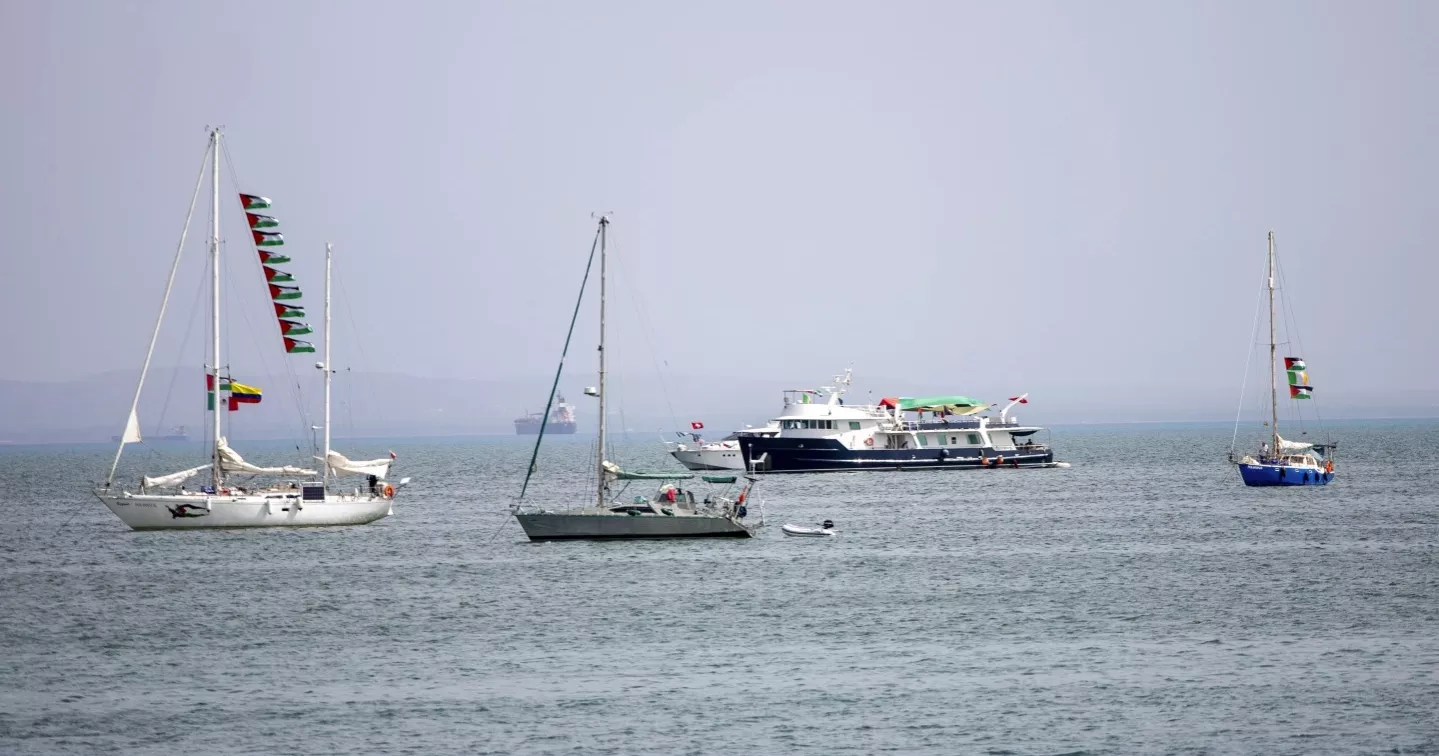
Activists aboard a flotilla sailing toward Gaza said late Wednesday that Israeli naval forces intercepted three of its vessels as they neared the blockaded Palestinian territory. Israeli authorities confirmed the operation, saying the activists – including Swedish climate campaigner Greta Thunberg – were safe and being transferred to Israel.
The Global Sumud Flotilla, consisting of nearly 50 boats and about 500 activists, had set out with symbolic humanitarian aid for Gaza. Organizers said the boats Sirius, Alma and Adara were stopped roughly 70 nautical miles (80 miles) from Gaza’s coast. The convoy includes Nelson Mandela’s grandson Mandla Mandela, former Barcelona Mayor Ada Colau, and several European lawmakers.
Greg Stoker, an American veteran aboard the Ohwayla, said about a dozen Israeli naval ships approached without transponders. “They are hailing our vessels, ordering us to cut engines or face seizure,” he said in a video posted online, adding that some boats were hit with water cannons.
Israel’s Foreign Ministry later released footage of Thunberg on deck, saying she and others were “safe and healthy.” Italian Foreign Minister Antonio Tajani told state television that the operation would last two to three hours, after which the boats would be towed to Ashdod port and the activists deported.
Turkey strongly condemned the interception, calling it “an act of terrorism” and a breach of international law, and demanded the release of its citizens and other passengers.
‘Danger zone’ encounter
The flotilla, which began its journey from Barcelona a month ago, was broadcasting live as it sailed north of Egypt in international waters. Activists called it a “danger zone” – an area where the Israeli navy has previously intercepted Gaza-bound boats.
Earlier Wednesday, flotilla members reported spotting unidentified vessels on radar, put on life vests and livestreamed the moment Israeli forces approached. Some threw their phones into the sea before boarding began.
Organizers had acknowledged reaching Gaza was unlikely, but said this was the largest attempt yet to challenge Israel’s 18-year blockade of the territory. Demonstrators carried banners reading “Free Palestine” and played music as they pressed forward.
Israel and global reaction
Israel’s Foreign Ministry warned the flotilla earlier that it was nearing an “active combat zone” and offered to deliver the aid to Gaza through established channels. Foreign Minister Gideon Saar denounced the convoy as a “provocation” and accused some members of links to Hamas – a charge activists dismissed as baseless.
European governments were split: Italy urged activists to turn back, while Spain defended their mission. Spanish Prime Minister Pedro Sánchez said, “It is a humanitarian mission that wouldn’t exist if Israel had allowed aid in. Spaniards taking part will have full diplomatic protection.”
The legal dispute
Under international maritime law, states have jurisdiction up to 12 nautical miles from their coast. Beyond that, ships in international waters cannot normally be seized – though exceptions apply in wartime blockades.
Israeli legal experts argue the Gaza blockade is militarily justified to prevent weapons smuggling, giving Israel the right to intercept vessels after warnings. But flotilla organizers and other experts counter that international law protects unarmed humanitarian missions.
“If the basic needs of Gaza’s population are not being met, there is a right to deliver humanitarian aid by sea under certain conditions,” said Omer Shatz, an Israeli international law scholar. “Israel can inspect the cargo – but stopping the mission altogether violates that principle.”
Source: AP