Israel announced on Saturday that it had retrieved the body of a Thai national taken hostage during the October 7 Hamas-led attack that triggered the current war in Gaza. At the same time, the ongoing Israeli military campaign has reportedly killed at least 95 people in the past day, according to Gaza’s health ministry.
The recovered hostage, Nattapong Pinta, had traveled to Israel for agricultural work. Israeli officials said he was captured from Kibbutz Nir Oz and killed early in the conflict. Thailand’s foreign ministry noted that the remains of two more Thai nationals are still missing. Thais were the largest group of foreign nationals abducted during the attack, many of whom lived and worked in southern Israeli communities that were among the first targets. According to Thai officials, 46 Thai citizens have been killed in the war.
Defense officials said Pinta’s body was found in Rafah, southern Gaza. The army attributed the abduction to the Mujahideen Brigades, a smaller armed faction also responsible for capturing Israeli-American hostages Judih Weinstein and Gad Haggai, whose remains were recovered just days earlier.
On Saturday, Israeli forces announced they had killed Mujahideen Brigades leader As’ad Aby Sharaiya in Gaza City.
Currently, 55 hostages are still believed to be held in Gaza, with Israeli authorities saying more than half are presumed dead. Families of the hostages again gathered in Tel Aviv to call for a ceasefire deal that could bring their loved ones home.
Hamas issued a rare statement warning that Israel was endangering hostage Matan Zangauker by surrounding the area where he is believed to be held. His mother, Einav, spoke at the rally, warning that the military’s actions could cost the lives of hostages like her son.
Civilians Among the Dead as Israeli Strikes Continue
A strike in Gaza City killed six members of one family, including two children, according to Shifa and al-Ahli hospitals. The military said the strike targeted the Mujahideen Brigades commander.
In other areas, four Israeli strikes hit the Muwasi region in southern Gaza. In the north, a strike on an apartment killed seven people, including a mother and five children. The victims were brought to Shifa Hospital.
“This is the reality of destruction,” a grieving man said as he carried a child's body from the scene. Another woman tearfully pleaded with her deceased loved one, “Stand up, my love.”
Israel said the strikes were part of its broader mission to dismantle Hamas and prevent future attacks, adding that it takes steps to minimize harm to civilians.
Deadly Incidents Linked to Food Aid Distribution
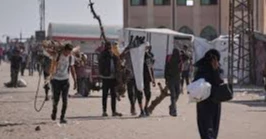
Nasser Hospital reported receiving six bodies of people killed while trying to collect food aid. With farming infrastructure devastated and ongoing blockades, more than 2 million people in Gaza depend on humanitarian assistance. International experts continue to warn of impending famine.
The Israeli military said the aid distribution zone is an active combat area at night. Officials claimed troops gave verbal warnings and fired warning shots at individuals deemed a threat near Tel al-Sultan.
An unnamed army official said the shooting happened about a kilometer from the food distribution site.
In recent weeks, gunfire near new aid hubs has become frequent. Over 80 people have been killed near these sites, according to hospital officials in Gaza. Israel says troops have only fired warning shots or at individuals who approached them in threatening ways.
The new aid system is being run by the Gaza Humanitarian Foundation (GHF), a group of mostly American contractors, which Israel wants to replace the United Nations and established aid organizations. On Saturday, GHF said it suspended food distribution due to threats from Hamas, though Hamas has not responded publicly.
Israel has accused Hamas of diverting aid under the previous U.N.-led system—an allegation the U.N. and aid agencies deny. They argue the new model allows Israel to weaponize aid, violates humanitarian standards, and is ineffective.
Due to Israeli restrictions and general insecurity, the U.N. says it has been unable to deliver most of the aid currently waiting in Gaza.
Meanwhile, Palestinians queued up at a soup kitchen in Gaza City on the second day of Eid al-Adha.
“I’ve been waiting here for over an hour and I feel like I have heatstroke,” said Farida al-Sayed, who is trying to feed her family of six. “All I had left were lentils, and even those are gone.”
Casualties and Displacement Since War Began
The war began with the October 7 Hamas-led attack that killed roughly 1,200 people, mostly civilians, and saw 251 hostages taken. While many hostages have been released through negotiations, Israeli forces have rescued eight alive and recovered numerous bodies.
Since then, Israeli military operations have killed over 54,000 Palestinians, most of them women and children, according to Gaza's health ministry. The fighting has devastated the region and displaced nearly 90% of the enclave’s 2 million residents.