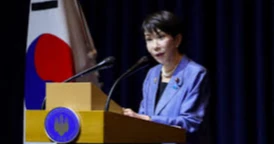
Tensions flared between Japan and China on Monday after Japanese Prime Minister Sanae Takaichi suggested that a Chinese military strike on Taiwan could pose “a survival-threatening situation” for Japan, potentially justifying the use of force.
Takaichi, who became Japan’s first female prime minister last month, said Friday that any Chinese military aggression near Taiwan would represent “an existential threat.” Her remarks drew swift condemnation from Beijing over the weekend.
In a now-deleted post on X (formerly Twitter), Chinese Consul General Xue Jian lashed out, writing, “We have no choice but to cut off that dirty neck lunging at us. Are you ready?” He also accused Takaichi and former Prime Minister Shinzo Abe of “blatant interference in China’s internal affairs” for previously claiming that “a Taiwan emergency is a Japan emergency,” and demanded an apology.
On Monday, Chief Cabinet Secretary Minoru Kihara said Japan had formally protested to Beijing, calling Xue’s remarks “extremely inappropriate.” Tokyo’s Foreign Ministry demanded that the post be deleted and requested an explanation from China.
The exchange signals possible turbulence ahead for Japan-China relations under Takaichi, despite what had appeared to be a cordial meeting between her and Chinese President Xi Jinping during the recent APEC summit in South Korea. The Japanese leader has vowed to strengthen national defense and met Taiwan’s representative to the summit a day after seeing Xi — a move that further angered Beijing.
In response, Chinese Foreign Ministry spokesperson Lin Jian said Xue’s post was “a personal response” to what he described as “erroneous and dangerous comments” supporting Taiwan’s separation from China. He accused Japanese politicians and media of “hyping” the issue to mislead the public.
Lin confirmed that Beijing had filed a “solemn protest” with Tokyo, questioning Japan’s intentions: “Is Japan trying to challenge China’s core interests and obstruct national reunification? Where does Japan want to take China-Japan relations?”
China views Taiwan as part of its territory and has not ruled out using force to achieve reunification.
The controversy began Friday when Takaichi, during a parliamentary session, was asked what scenarios could threaten Japan’s security. She cited a possible Chinese naval blockade of Taiwan or military actions blocking U.S. forces as examples that could qualify as a “survival-threatening situation,” under which Japan could legally use force for self-defense.
Her statement, seen as tougher than those of past leaders, sparked criticism and forced her to later clarify that her position remained consistent with Japan’s previous official stance.