
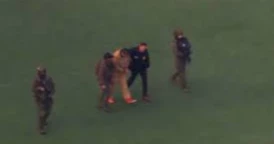
Former Venezuelan leader Nicolás Maduro defiantly proclaimed himself “the president of my country” on Monday as he rejected federal drug trafficking charges in a New York courtroom, denouncing what he described as his forcible capture by U.S. authorities.
“I was abducted,” Maduro said in Spanish through an interpreter before the judge halted his remarks. When formally asked to enter a plea, he responded: “I am innocent. I am not guilty. I am a decent man and the constitutional president of my country.”
The appearance marked Maduro’s first time in a U.S. courtroom since he and his wife, Cilia Flores, were taken from their home in Caracas during a surprise overnight military operation on Saturday. Flores also entered a not-guilty plea. The case represents one of the most significant U.S. criminal prosecutions ever brought against a foreign head of state.
The legal proceedings are unfolding amid sweeping geopolitical consequences following President Donald Trump’s assertion that Maduro’s removal would allow Washington to temporarily oversee Venezuela’s affairs.
Maduro, 63, was transported to Manhattan under heavy security early Monday, arriving by helicopter from a Brooklyn detention facility before being driven in an armored convoy to the courthouse. He and Flores appeared shortly before noon, wearing jail uniforms and leg restraints, and listened to the English-language hearing through Spanish translation headsets.
As Maduro exited the courtroom, someone in the gallery shouted that he was an “illegitimate” leader.
Legal battle begins
Although Maduro will technically receive the same legal rights as any U.S. criminal defendant — including the right to a jury trial — his case is unusual given the manner of his arrest and the international implications involved.
From the outset, Maduro insisted that he had been unlawfully seized.
“I have been held here since Saturday, January 3,” he said, leaning toward the microphone. “I was taken from my home in Caracas.”
U.S. District Judge Alvin Hellerstein interrupted, telling Maduro that his objections would be addressed later through his attorney. The judge then asked a single question: “Are you Nicolás Maduro Moros?”
“I am Nicolás Maduro Moros,” he replied.
Maduro’s attorney, Barry Pollack, said the defense plans to challenge the legality of what he called a “military kidnapping.” Pollack argued that Maduro, as head of a sovereign state, is entitled to diplomatic immunity.
A similar argument failed in the case of Panamanian leader Manuel Noriega following his U.S. capture in 1990. Washington does not recognize Maduro as Venezuela’s legitimate president, particularly after his disputed reelection in 2024.
Flores, who introduced herself in court as Venezuela’s first lady, appeared with visible bandages on her head. Her lawyer said she sustained serious injuries during the operation.
A sweeping 25-page indictment accuses Maduro and associates of conspiring with drug cartels to ship massive quantities of cocaine into the United States. If convicted, they could face life sentences.
The charges allege that Maduro and Flores ordered kidnappings, assaults, and killings to enforce their trafficking operation, including the murder of a local drug figure in Caracas.
Outside the courthouse, police separated demonstrators protesting the U.S. action from those supporting it. Inside, as the hearing concluded, a Venezuelan man stood and confronted Maduro in Spanish. The former leader responded sharply as he was escorted out, saying: “I am a kidnapped president. I am a prisoner of war.”
Calls for Maduro’s return
Trump said over the weekend that the United States would temporarily “run” Venezuela, reiterating on Sunday that “we’re in charge.”
Secretary of State Marco Rubio later sought to soften the message, saying the U.S. would not manage Venezuela’s daily governance beyond enforcing an existing oil embargo.
Before his capture, Maduro had accused Washington of targeting him to gain control of Venezuela’s oil and mineral wealth. While Trump suggested the move could boost oil exports, prices climbed 1.7% on Monday amid uncertainty over Venezuela’s capacity to revive production.
Venezuela’s interim leader, Delcy Rodríguez, demanded Maduro’s return, though she later struck a more conciliatory tone, expressing openness to cooperation with Washington. She was sworn in Monday by her brother, National Assembly President Jorge Rodríguez.
Speaking during the ceremony, she condemned the U.S. operation and described Maduro and Flores as heroes who had been kidnapped.
Maduro’s son, lawmaker Nicolás Maduro Guerra, warned that the seizure of a sitting head of state could set a dangerous global precedent.
“If abducting a president becomes acceptable, no country is safe,” he said. “Today it is Venezuela. Tomorrow it could be anyone.”
The United Nations Security Council convened an emergency session on Monday, with senior U.N. officials cautioning that the U.S. action may have breached international law and highlighting Venezuela’s deep humanitarian crisis following years of economic turmoil.