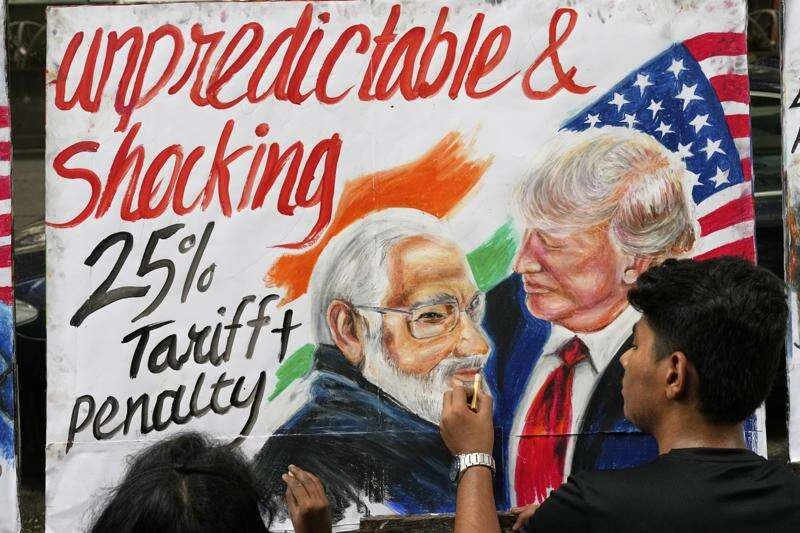
The once-warm camaraderie between Indian Prime Minister Narendra Modi and former U.S. President Donald Trump appears to be cooling, as a series of diplomatic and trade tensions cast a shadow over what was once hailed as a uniquely strong partnership between the two populist leaders.
The relationship, previously marked by joint stadium appearances and mutual praise, has come under strain due to Trump’s recent remarks and policy decisions—most notably his imposition of new tariffs and criticism over India’s energy ties with Russia.
Tensions escalated last week after Trump announced a 25% tariff on Indian goods and hinted at additional penalties over India's continued purchase of Russian oil. In a social media post, Trump referred to India’s economy as “dead” and accused the country of profiting from reselling Russian oil while ignoring the war in Ukraine.
India, Philippines Strengthen Defense, Maritime Cooperation with New Pact
A White House official, speaking anonymously, said Trump’s remarks reflect his dissatisfaction with the slow pace of trade negotiations rather than any shift in Washington’s strategic position. Still, the comments have unsettled policymakers in New Delhi.
Ashok Malik, a former adviser in India’s Foreign Ministry, called the moment a “testing time” for India-U.S. ties. He warned that “decades of bipartisan cooperation” risk being undermined by “fast and loose” statements and online rhetoric. Malik now leads the India office of The Asia Group, a U.S.-based advisory firm.
Malik also said India’s current offer to the U.S. is the most ambitious trade proposal in its history, reportedly including access for American agricultural products—an area of domestic political sensitivity for Modi.
Strategic Worries Over Pakistan
Beyond trade, concerns have also emerged over what New Delhi perceives as a renewed U.S. tilt toward Pakistan. Trump’s repeated claims of mediating the Kashmir dispute, as well as his praise for Pakistan’s counterterrorism efforts, have fueled suspicion in India.
In May, tensions between India and Pakistan flared into military skirmishes in Kashmir. While Trump has claimed he played a role in de-escalation, India maintains Kashmir is an internal matter and opposes third-party involvement.
Trump’s announcement of a large oil exploration deal with Pakistan, shortly after criticizing India, further deepened unease in New Delhi.
Sreeram Sundar Chaulia of the Jindal School of International Affairs said Trump’s remarks have “soured the mood in India” and warned that deeper U.S.-Pakistan cooperation could “dent the U.S.-India strategic partnership.”
Russian Oil at the Center of Friction
India’s continued purchase of Russian oil remains a core issue. Despite pressure from the previous Biden administration to reduce imports following the invasion of Ukraine, India expanded its energy trade with Moscow. Trump has now taken a harder stance, saying India’s actions are helping finance Russia’s war.
Stephen Miller, a senior White House official, echoed these sentiments, calling India’s trade with Russia “unacceptable.” Trump followed up with more social media criticism, accusing India of profiting at Ukraine’s expense.
While some analysts believe Trump’s threats are negotiation tactics, the rhetoric has nonetheless stirred concern in New Delhi.
India Responds with Measured Tone
Despite rising tensions, India’s response has so far been cautious. Commerce Minister Piyush Goyal reiterated that both sides are working toward a fair and balanced trade agreement. However, a late statement from the Ministry of External Affairs described Trump’s remarks as “unjustified and unreasonable.”
India signals continued Russian oil imports despite Trump’s tariff threats
The statement defended India's oil imports from Russia, citing global market constraints after European countries diverted their energy sources. It also pointed out that many Western nations criticizing India continue to trade with Russia themselves.
“India will take all necessary steps to safeguard its national interest and economic security,” the ministry said.
As the world’s two largest democracies navigate these latest challenges, observers warn that the personal warmth once shared by their leaders may no longer be enough to hold the relationship together.
Source: Agency