
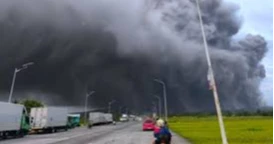
More than 300 families were forced to leave their homes in the Philippines after heavy ashfall from Mayon volcano over the weekend, authorities said Monday.
Officials said the ash emissions were triggered not by a major eruption but by the collapse of accumulated lava on the volcano’s slopes. The material rushed down the southwestern flank in a fast-moving pyroclastic flow—an intense surge of hot rocks, ash and gas—before nightfall on Saturday, according to Teresito Bacolcol, head of the Philippine Institute of Volcanology and Seismology.
Although no casualties were reported, ash spread across 87 villages in three towns, taking many residents by surprise and reducing visibility on roads, which disrupted traffic.
“The ashfall was extremely dense, and visibility dropped to zero even along the national highway,” said Camalig Mayor Caloy Baldo, whose town sits near the base of the volcano.
He added that while some residents initially panicked, authorities urged them to remain calm.
The ashfall also damaged vegetable farms and killed several livestock, including four water buffaloes and a cow in Camalig. Cleanup efforts are now underway in the town, which has a population of about 8,000 in Albay province.
Bacolcol said conditions around Mayon had since stabilized, but warned that risks remain.
Standing at 2,462 meters (8,077 feet), Mayon is known for its near-perfect cone shape and is a major tourist attraction, but it is also the most active among the Philippines’ 24 volcanoes.
Authorities raised the alert level to 3 in January following a series of mild eruptions that triggered intermittent rockfalls and hazardous pyroclastic flows. The highest alert level, 5, indicates a dangerous explosive eruption with widespread ashfall and lava flows.