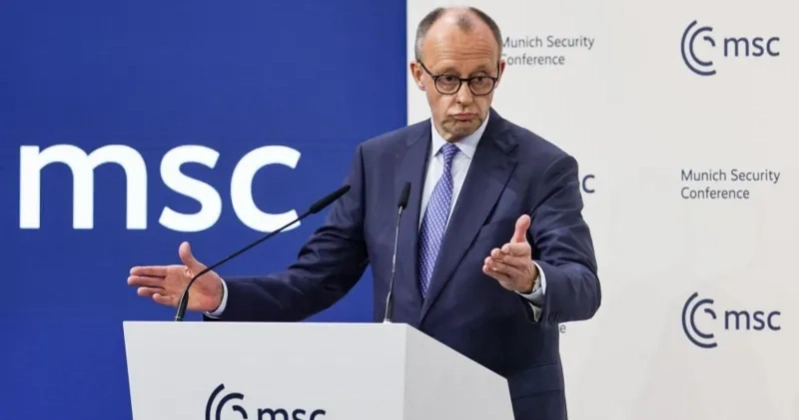
German Chancellor Friedrich Merz on Friday warned that the rules-based global order has effectively collapsed, cautioning that Europe can no longer take its freedom and security for granted amid rising great-power politics.
Opening the annual Munich Security Conference, Merz told world leaders that the international system “no longer exists in that form,” urging Europeans to be ready to make sacrifices to defend their values and security.
He acknowledged that a “deep divide” has emerged between Europe and the United States, saying transatlantic relations have been strained by ideological and policy differences in recent years.
The conference is taking place against a backdrop of heightened tensions, including US President Donald Trump’s renewed threats to annex Greenland from Denmark and the imposition of tariffs on European imports, developments that have unsettled European allies.
US Secretary of State Marco Rubio, who is attending the conference and is scheduled to speak later, earlier described the current moment as a “new era in geopolitics,” calling for a reassessment of global roles and responsibilities.
Around 50 world leaders are attending the summit, where European defence, the future of the transatlantic relationship and the credibility of the North Atlantic Treaty Organization are high on the agenda. US commitments to Nato have come under scrutiny amid shifting American foreign policy priorities.
Merz said Europe does not share the “culture war” politics associated with the US MAGA movement, stressing that freedom of speech in Europe is bound by constitutional values and human dignity. He also rejected protectionism, reaffirming Europe’s commitment to free trade.
Despite the tensions, Merz appealed for renewed cooperation, urging Washington to help “repair and revive transatlantic trust.” He also revealed that confidential discussions are underway with French President Emmanuel Macron on the possibility of a joint European nuclear deterrent, though he did not provide details.
France and the UK are currently Europe’s only nuclear powers, while most European states, including Germany, rely on the US nuclear umbrella under Nato.
Addressing the conference later, Macron reiterated his call for Europe to become a geopolitical power, urging faster and more coordinated rearmament across the continent in response to Russia’s invasion of Ukraine. He described the war as Europe’s “existential challenge” and warned against yielding to Russian demands.
The Russia-Ukraine war, tensions between the West and China, and prospects of a renewed Iran-US nuclear deal are also being discussed at the high-profile gathering.
With inputs from BBC