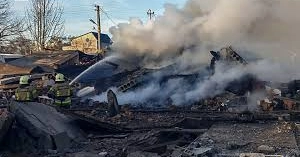
Russian forces launched a sweeping overnight assault on Ukraine, firing hundreds of drones and dozens of missiles, Ukrainian officials said Friday. The attack killed at least four people in Kyiv and marked only the second time in the nearly four-year war that Moscow has used its new, nuclear-capable hypersonic ballistic missile, a move widely seen as a warning to Ukraine’s NATO partners.
The large-scale barrage, which included the launch of the Oreshnik missile, came just days after Ukraine and its allies reported progress toward a framework to prevent future Russian aggression should a U.S.-backed peace agreement be reached.
European leaders denounced the strike as “escalatory and unacceptable,” while the European Union’s chief diplomat said President Vladimir Putin’s response to diplomatic efforts amounted to “more missiles and destruction.”
The assault also occurred amid rising tensions between Moscow and Washington following Russia’s criticism of the U.S. seizure of an oil tanker in the North Atlantic. It coincided with U.S. President Donald Trump signaling support for tougher sanctions aimed at severely damaging Russia’s economy, as Moscow has shown no willingness to retreat from its hardline demands on Ukraine.
Kyiv left without heat amid winter cold
Ukrainian authorities reported that at least four people were killed and 25 wounded in Kyiv after residential buildings were struck during the overnight bombardment.
Among the dead was an emergency medical worker, according to Kyiv City Military Administration head Tymur Tkachenko. Four doctors and a police officer were injured while responding to the strikes.
Roughly half of Kyiv’s apartment buildings — about 6,000 — lost heating as temperatures hovered near minus 8 degrees Celsius (17.6 Fahrenheit), Mayor Vitali Klitschko said. Water services were also disrupted.
City crews restored electricity and heat to essential public facilities, including hospitals and maternity wards, using mobile boiler units, Klitschko added.
President Volodymyr Zelenskyy said the attack damaged the Qatari Embassy in Kyiv, noting Qatar’s important role in mediating prisoner exchanges between the two countries. He called for a firm international response, particularly from the United States, which he said Russia still takes seriously.
Moscow calls strike retaliation
Ukraine’s Security Service said it recovered fragments of the Oreshnik missile in the western Lviv region. Investigators said the missile was launched from Russia’s Kapustin Yar test site near the Caspian Sea and struck civilian infrastructure.
“I heard a very loud explosion,” said Lviv resident Kristofer Chokhovich, who identified himself as an American. “That’s normal in this war. Ukraine is strong, and it doesn’t matter how many missiles they send.”
Another resident, Ulyana Fedun, said the strike was unpleasant but no longer frightening after years of living under constant threat.
Russia’s Defense Ministry claimed the attack was retaliation for an alleged Ukrainian drone strike on one of Putin’s residences last month — a claim denied by both Trump and Ukrainian officials.
While Moscow did not disclose the missile’s target, Russian media and military bloggers reported it hit an underground gas storage facility in the Lviv region, an area near a key supply route through Poland used to deliver Western military aid.
Putin has previously said the Oreshnik travels at speeds of up to Mach 10 and cannot be intercepted by existing missile defenses. He has warned that multiple conventional launches could rival the destructive power of a nuclear strike and has threatened to use the weapon against countries aiding Ukraine’s long-range attacks inside Russia.
Ukrainian intelligence says the missile carries six warheads, each equipped with six submunitions.
Russia first deployed the Oreshnik against the city of Dnipro in November 2024. Analysts say the weapon adds a new psychological dimension to the war, intimidating both Ukrainian civilians and Western supporters.
Ukraine seeks global action
Foreign Minister Andrii Sybiha said Ukraine would pursue international measures in response to the missile strike, including requesting an emergency meeting of the U.N. Security Council and consultations with NATO.
He said the strike near EU and NATO borders posed a serious threat to European security and called for strong international consequences for Russia’s actions.
A U.N. diplomat said Ukraine’s request had been formally delivered and that six Security Council members have already called for a meeting, though no date has been finalized.
Pope Leo XIV urged the global community to intensify efforts toward peace, calling for an immediate ceasefire and renewed dialogue to end the suffering in Ukraine.
Leaders of Britain, France, and Germany said they discussed the attack and agreed it represented a dangerous escalation.
EU foreign policy chief Kaja Kallas said the Oreshnik launch was intended to send a message to Europe and the United States, adding that Russia’s actions show it has no genuine interest in peace.
Residential areas hit in Kyiv
Several Kyiv neighborhoods were damaged in the overnight attack. In the Desnyanskyi district, a drone struck the roof of a high-rise building and damaged the lower floors of another residential structure. In the Dnipro district, falling drone debris caused damage and sparked a fire in an apartment building.
Resident Dmytro Karpenko said his windows were blown out by the blast. When he saw his neighbor’s home on fire, he ran to help.
“What Russia is doing proves they don’t want peace,” the 45-year-old said. “People are suffering, and people are dying — but they still want peace.”