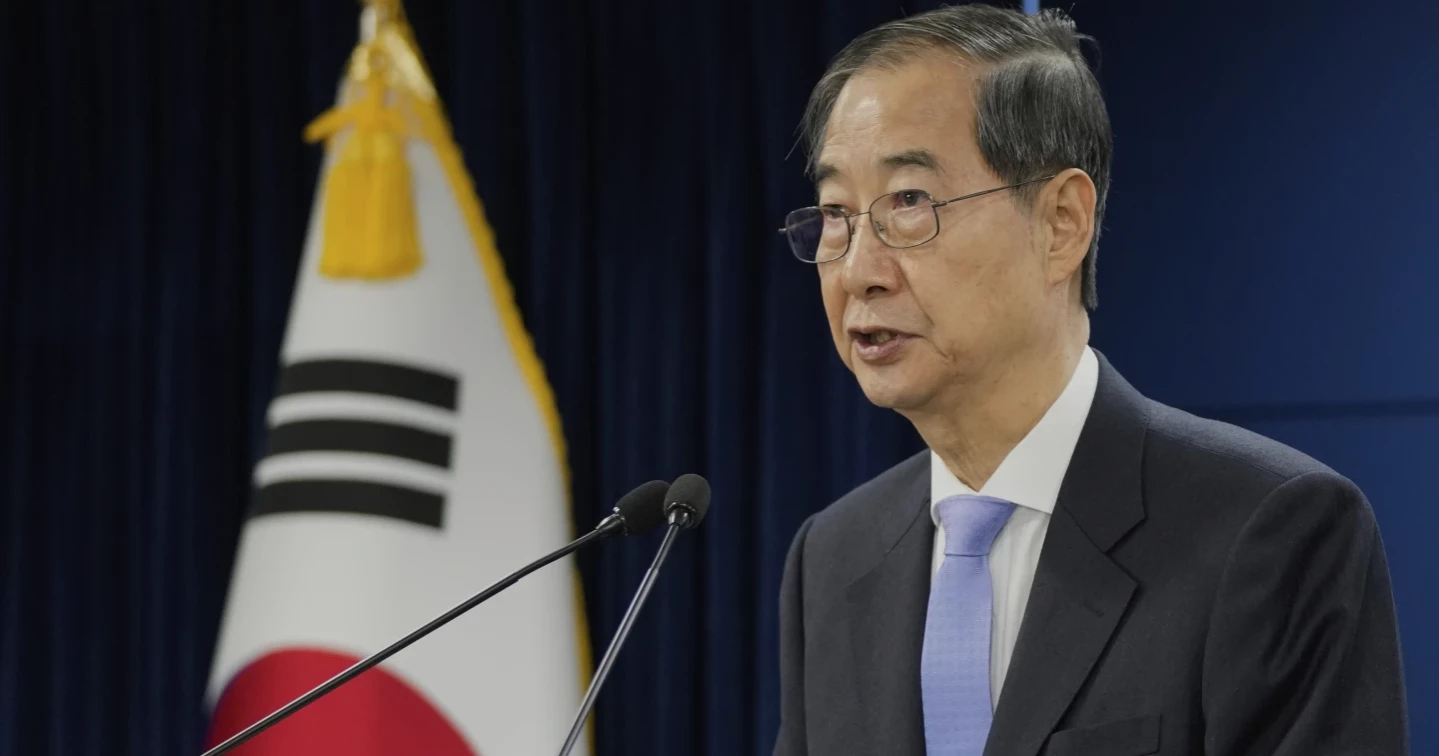
South Korea’s Constitutional Court has overturned the impeachment of Prime Minister Han Duck-soo, reinstating him as acting leader on Monday. However, the court has yet to rule on the separate impeachment of President Yoon Suk Yeol over his declaration of martial law in December.
Implications of the Ruling
Observers noted that the 7-1 decision in Han's case does not necessarily indicate how the court will rule on Yoon’s impeachment, as Han was not central to the martial law declaration. However, the ruling may embolden Yoon’s supporters and escalate political tensions with the opposition.
Following his reinstatement, Han expressed gratitude to the court for what he termed a “wise decision” and vowed to prioritize pressing issues, including global trade challenges—an apparent reference to the Trump administration’s tariff policies. Calling for national unity, he stated, “There’s no left or right—what matters is the advancement of our nation.”
Background: Political Turmoil and Impeachment
South Korea has been in political crisis since Yoon, a conservative, declared martial law on December 3, deploying troops to the opposition-controlled National Assembly and other locations in Seoul. The decree lasted just six hours before lawmakers convened and successfully voted to nullify it.
On December 14, the assembly impeached Yoon, accusing him of violating the Constitution and attempting to suppress political opposition. Han assumed the role of acting president until his own impeachment later that month.
The dual impeachments of South Korea’s top two leaders have deepened domestic political divisions and raised concerns about the country’s economic and diplomatic stability.
Key Factors in Han’s Impeachment
One major factor in Han’s impeachment was his refusal to fill three vacant seats on the nine-member Constitutional Court, a move that could have influenced the outcome of Yoon’s impeachment ruling. His successor as acting president, Choi Sang-mok, later appointed two justices but left one seat vacant.
Han also faced allegations of abetting Yoon’s martial law order and obstructing independent investigations into potential rebellion charges against Yoon.
Japan China and South Korea discuss trilateral cooperation
On Monday, seven of the court’s eight justices ruled against Han’s impeachment, stating that his actions were either not illegal or not severe enough to justify removal. Additionally, they noted procedural flaws in the impeachment motion. One justice dissented, supporting Han’s impeachment.
Political Reactions
The main liberal opposition Democratic Party criticized the court’s decision, urging it to remove Yoon swiftly. Meanwhile, Yoon’s office welcomed the ruling, calling the opposition’s repeated impeachment efforts “reckless, malicious political offensives.”
Uncertainty Over Yoon’s Future
Initially, analysts expected a verdict on Yoon’s impeachment by mid-March, but the delay has fueled speculation about the court’s reasoning.
“Today’s verdict will energize both Yoon’s supporters and opponents,” said Duyeon Kim, a senior analyst at the Center for a New American Security in Washington. “However, given the differences in allegations, it’s too early to predict the court’s ruling on Yoon.”
Kim noted that Han’s reinstatement, given his bureaucratic background, would likely stabilize the country compared to the uncertainty during his suspension.
Public Opinion and Political Divisions
Mass protests for and against Yoon have erupted across South Korea. Initial polls showed widespread disapproval of Yoon’s martial law order, though his support has recently strengthened.
Yoon contends that his declaration was a necessary measure to counter the Democratic Party’s obstruction of his policies and impeachment motions against key officials. Critics argue he sought to use military rule to avoid investigations into corruption scandals involving him and his wife.
Senior military and police officials have testified that Yoon ordered them to remove lawmakers from the assembly to prevent a vote against his decree. Yoon, however, insists the troop deployment was meant to maintain order.
Japan's leader calls for common ground ahead of key meeting with China and South Korea
Potential Outcomes
If the court upholds Yoon’s impeachment, a new presidential election will be required. If it overturns the decision, Yoon will regain his full presidential powers.
Separately, Yoon faces charges of directing rebellion, a crime punishable by life imprisonment or the death penalty if convicted.
Source: With input from agency