
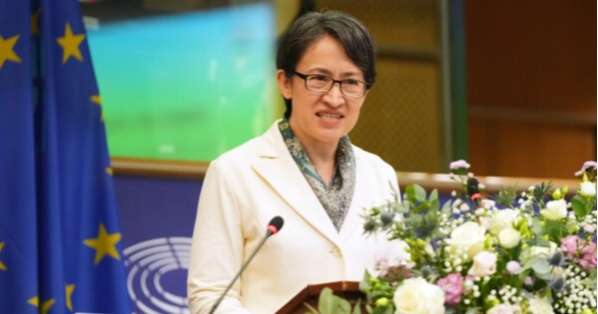
Taiwan’s Vice President Bi-Khim Hsiao on Friday called on the European Union to deepen security, trade, and technological cooperation with the self-governing island, while defending its democracy against growing threats from China.
Speaking to international lawmakers at a China-focused conference in the European Parliament building, Hsiao said, “Peace in the Taiwan Strait is essential to global stability and economic continuity,” and stressed the importance of opposing any unilateral attempts to alter the status quo by force.
Hsiao urged European lawmakers, including representatives from Germany and Spain, to work more closely with Taiwan on trusted supply chains and AI technology. She also highlighted parallels between Taiwan facing cyberattacks and disruptions to undersea internet cables and hybrid attacks experienced by European countries since Russia’s invasion of Ukraine.
While the EU has no formal diplomatic relations with Taiwan under the “One China” policy, Hsiao emphasized shared democratic values and close trade ties, urging Brussels to build a “reliable technology ecosystem rooted in trust, transparency and democratic values.”
China criticized Hsiao’s visit, calling it a violation of its sovereignty and the one-China principle, and condemned the EU parliament for allowing “separatist activities.” China maintains that Taiwan is part of its territory and has repeatedly threatened to annex the island by force if necessary.
Hsiao’s address comes amid heightened security concerns, with Taiwan planning to boost its defense budget to 5% of GDP by 2030 and accelerate its air defense system, “T-Dome,” in response to China’s increased military activities near the island.
The event was part of a conference organized by the Inter-Parliamentary Alliance on China, which brings together lawmakers from around the world to coordinate policy on China. Around 50 legislators from two dozen countries attended.
Analysts note that despite the lack of formal ties, stronger EU-Taiwan cooperation could help Europe mitigate risks from China’s growing pressure on the island, particularly in semiconductor and electronics supply chains, potentially more impactful than the effects of Russia’s invasion of Ukraine.