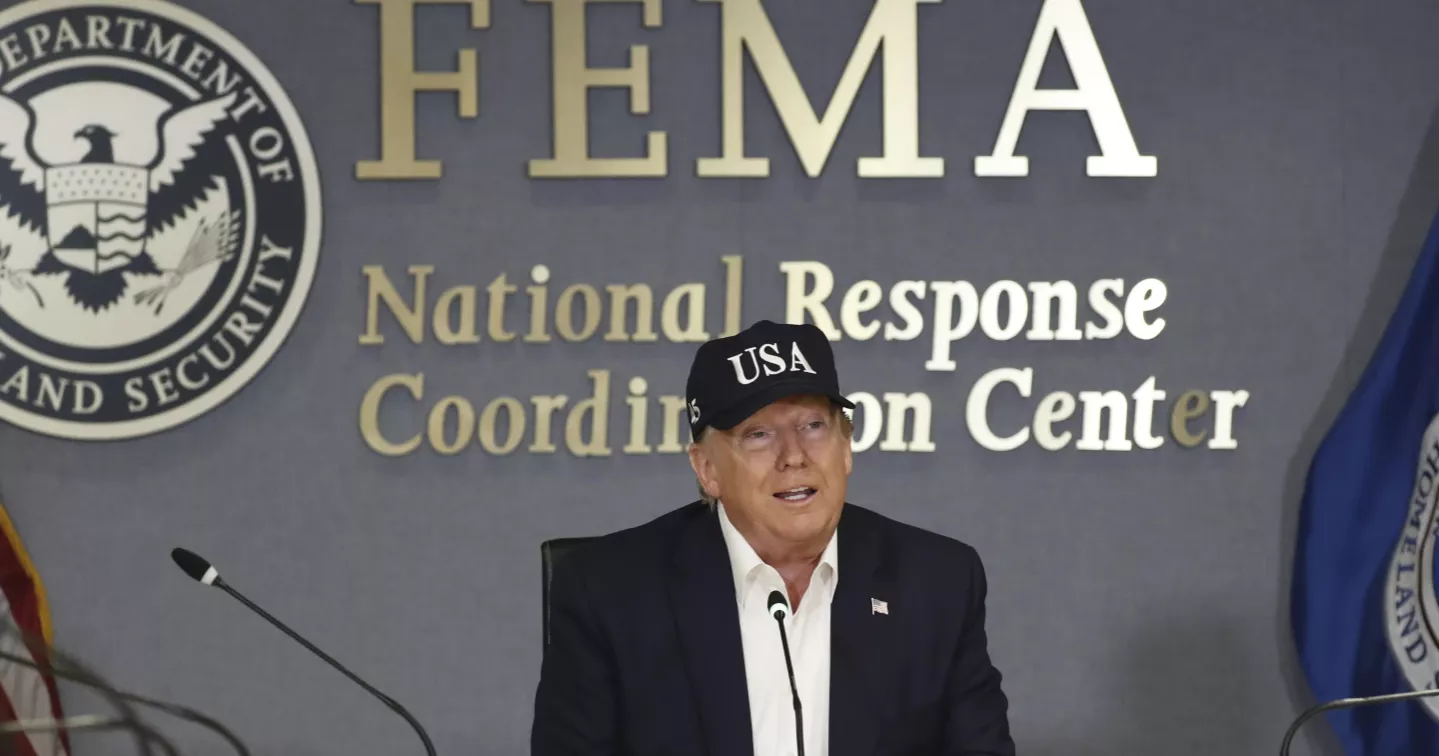
Just weeks ago, President Donald Trump announced plans to begin “phasing out” the Federal Emergency Management Agency (FEMA) after this hurricane season, aiming to “wean off of FEMA” and “bring it down to the state level.”
However, in response to the devastating floods in Texas, Trump and his administration are now emphasizing a fast and robust federal response, aligning more closely with the traditional federal disaster model rather than the dramatic reform the president previously proposed.
Trump approved Texas Governor Greg Abbott’s request for a major disaster declaration just one day after submission, activating FEMA resources and unlocking aid for survivors and local governments.
Homeland Security Secretary Kristi Noem told Trump during a presidential Cabinet meeting Tuesday morning that FEMA was quickly deploying funding and resources. “We’re cutting through the paperwork of the old FEMA, streamlining it, much like your vision of how FEMA should operate,” Noem said.
Noem noted that the rapid delivery of funds to Texas resembled the “state block grants” model Trump has promoted, which would replace FEMA’s current system of reimbursing states for response and recovery expenses at a cost-share of at least 75%.
Former FEMA officials, however, say it remains unclear how this response differs from FEMA’s typical role, which is to support states through coordination and funding. They emphasize that the vigorous federal response underscores the difficulty states would face if FEMA were dismantled.
“This is a defining event that can help them realize that a Federal Emergency Management Agency is essential,” said Michael Coen, FEMA chief of staff during the Obama and Biden administrations. “Imagine if an event like this happened a year from now, after FEMA is eliminated. What would the president or secretary (Noem) offer to the governor of Texas if there is no FEMA?”
The Department of Homeland Security and FEMA did not immediately respond to questions about Noem’s remarks, including whether FEMA was doing anything different in how it moved money to Texas or why the process resembled a block-grant system.
While Noem and Trump emphasize that Texas is leading the response and recovery efforts, this has always been FEMA’s role, said Justin Knighten, the agency's director of external affairs during the Biden administration. “The state is in the lead. FEMA is invited into the state to support,” Knighten explained.
He added that even experienced state emergency management offices face disasters that overwhelm their capacity: “When there’s capacity challenges and resource need, that’s where FEMA steps in.”
FEMA’s primary responsibilities include coordinating resources from other federal agencies such as the Army Corps of Engineers, Health and Human Services, and the Environmental Protection Agency.
Trump signs tax and spending cut bill at White House
The agency also manages first-responder support like nationwide search-and-rescue teams and reimburses their costs. Additionally, FEMA administers the National Flood Insurance Program and supports survivors through programs offering temporary housing and home repair assistance.
Disaster recovery centers have opened to help affected households apply for aid, according to Texas Emergency Management Chief Nim Kidd. The Public Assistance program reimburses state and local governments for infrastructure repair costs.
Experts warn that states would struggle to replace FEMA. “It’s true that Texas is very capable, but I think it’s something that people forget that FEMA pays for a lot of state and local emergency capacity,” said Maddie Sloan, director of the disaster recovery and fair housing project at Texas Appleseed.
She noted that much of the Texas Division of Emergency Management’s $2 billion budget comes from federal grants.
“If a state like Texas asks for federal assistance within two days, the smaller states that are less capable don’t stand a chance,” said Jeremy Edwards, FEMA's deputy director of public affairs during the Biden administration.
States would need to establish their own recovery programs and coordinate with multiple federal agencies if given block grants in place of FEMA involvement. “Without FEMA, a governor or a state has to be calling around and have a Rolodex of the whole federal government to call and try and figure out what support they can get,” Coen said.
While reforms could improve FEMA’s reimbursement process and support to survivors, experts warn that eliminating the agency risks large gaps in recovery. “We have spent a lot of time encouraging FEMA to be better, but if FEMA goes away, there is no help for individual families,” Sloan said.
Trump has deflected questions on what the Texas response means for FEMA’s future. A 12-member review council established by the president to propose FEMA reforms is scheduled to meet for the second time Wednesday.
Abbott and Kidd are members of the council. At the first meeting, Abbott described FEMA as “slow and clunky” and called for reforms to “streamline the effort.” He has praised Trump’s rapid disaster declaration in Texas.
Though no major reforms have been enacted yet, smaller policy changes could affect Texas’ recovery. This spring, the administration ended FEMA’s practice of door-to-door canvassing to help households enroll for assistance, calling it “wasteful and ineffective.” Many impacted areas in Kerr County and beyond still lack power and accessible roads, complicating aid applications.
Abbott’s request for hazard mitigation funding — a program that helps communities rebuild with resilience — is still pending. Trump has not approved any hazard mitigation assistance since February.