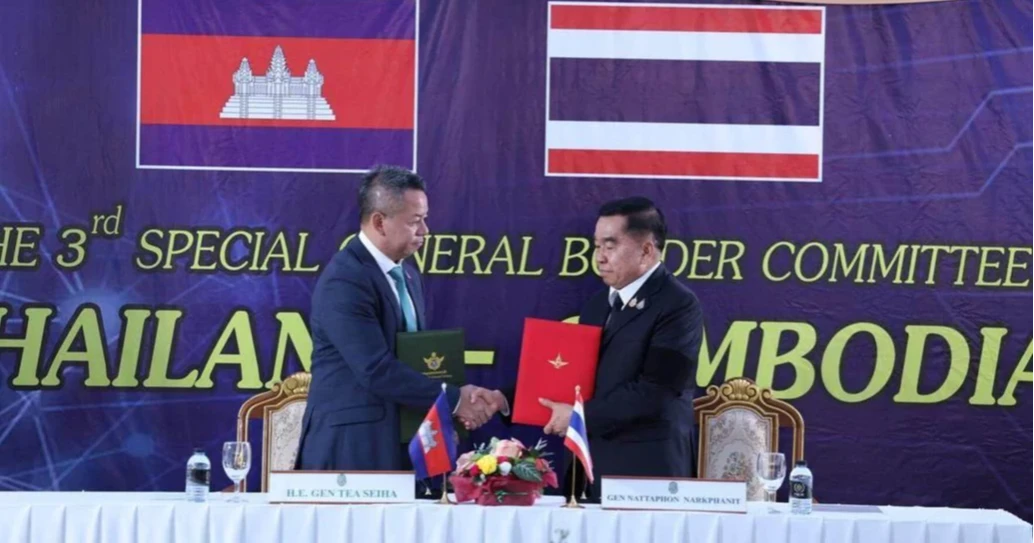
Thailand and Cambodia on Saturday signed a new ceasefire agreement to end weeks of armed clashes along their disputed border, with the truce taking effect at noon local time.
Under the agreement, both sides committed to immediately stop fighting, avoid further military movements, and refrain from violating each other’s airspace for military purposes. During the recent fighting, Thailand carried out airstrikes on Cambodian targets, including attacks reported earlier Saturday, according to Cambodia’s defense ministry.
The deal also states that Thailand will repatriate 18 Cambodian soldiers it has held since clashes in July, once the ceasefire holds for 72 hours. Their release had been a key demand from Cambodia.
The agreement was signed by Cambodia’s Defense Minister Tea Seiha and Thailand’s Defense Minister Nattaphon Narkphanit at a border checkpoint. It followed three days of talks by military officials under the framework of the General Border Committee.
The document reaffirms commitments made under a July ceasefire that ended five days of fighting and includes 16 measures aimed at de-escalation. That earlier truce was brokered by Malaysia following pressure from U.S. President Donald Trump and later formalized in October at a regional meeting in Malaysia.
Despite previous agreements, tensions persisted, with propaganda exchanges and sporadic violence escalating into heavy fighting in early December. Thai officials say 26 soldiers and one civilian have been killed since Dec. 7, while 44 civilians died due to indirect impacts of the conflict. Cambodia has reported 30 civilian deaths and 90 injuries but has not released military casualty figures. Hundreds of thousands of people have been displaced on both sides of the border.
Both countries accused each other of starting the fighting and said they acted in self-defense. The agreement also urges adherence to international bans on land mines, an issue raised by Thailand after several soldiers were wounded this year by explosions near the border. Cambodia said the mines were remnants of past conflicts.
The deal further commits both sides to avoid spreading false information, resume border demarcation efforts, and cooperate in combating transnational crimes, including large-scale online scam networks operating in the region.