
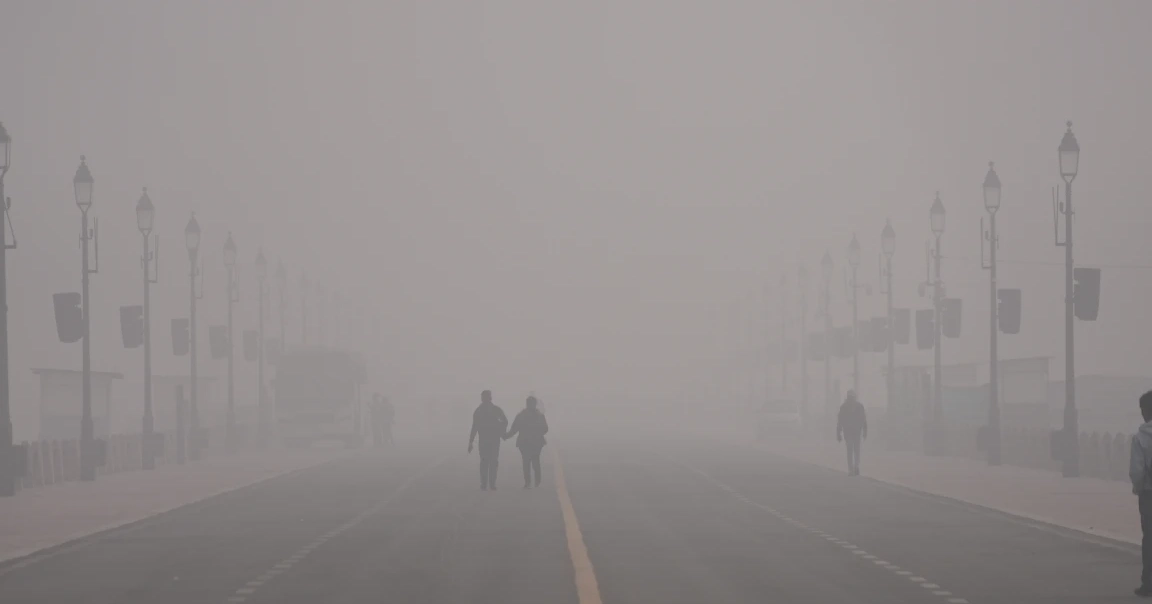
Dense smog shrouded India’s capital on Monday, sending air pollution to its worst levels in weeks, disrupting travel, and forcing authorities to implement strict containment measures.
More than 40 flights were cancelled, dozens more delayed, and over 50 trains arriving and departing from New Delhi faced multi-hour delays, officials said.
Healthcare experts warned residents to avoid outdoor activities as hospitals reported a surge in patients suffering from breathing difficulties and eye irritation.
“New Delhi is like a gas chamber right now. Air purifiers offer limited relief, so the government must come up with long-term solutions,” said Naresh Dang, a physician at Max Healthcare.
Delhi’s air quality has remained at the federal government’s “severe” level for the past two days, which can affect healthy individuals’ respiratory systems and seriously harm those with heart or lung conditions.
Official readings on Sunday exceeded 450 at multiple monitoring stations, up from 430 on Saturday, marking the highest levels this winter, according to the Central Pollution Control Board. Monday’s readings stood at 449. For reference, values below 50 are considered safe. During severe pollution, authorities advise people to stay indoors and wear N95 masks. Children, the elderly, pregnant women, and people with pre-existing respiratory or cardiovascular conditions are urged to take extra precautions.
“I have never seen such pollution before. Last year Delhi was bad, but this year it is worse. I can feel the smoke as I breathe,” said tourist Tiam Patel.
To curb pollution, the government has banned construction, restricted diesel generator and vehicle use, and deployed water sprinklers. Schools and offices are allowing students and employees to stay home.
Environmentalists, however, warn that these short-term measures are insufficient. New Delhi and its surrounding areas, home to over 30 million people, consistently rank among the world’s most polluted regions. Six of the world’s ten most polluted cities are in India, with New Delhi topping the list for national capitals, according to Switzerland-based IQAir.
Pollution spikes each winter due to crop residue burning in nearby states, combined with cooler temperatures that trap smoke from vehicles, construction, and industry. Levels often exceed the World Health Organization’s safe limit by 20 times.
“Delhi’s air is unhealthy year-round, even if it appears visibly worse from October to December,” said Vimlendu Jha, an environmentalist.
Earlier this month, residents protested against the government’s inaction on air pollution. A Lancet study last year linked long-term exposure to polluted air in India to 1.5 million additional deaths annually.
“Air pollution-related deaths are largely uncounted due to the lack of systematic tracking mechanisms,” said Shweta Narayan of the Global Climate and Health Alliance.
In October, authorities conducted a controversial cloud-seeding experiment over New Delhi to induce rainfall and clear smog, but the effort failed to produce rain.