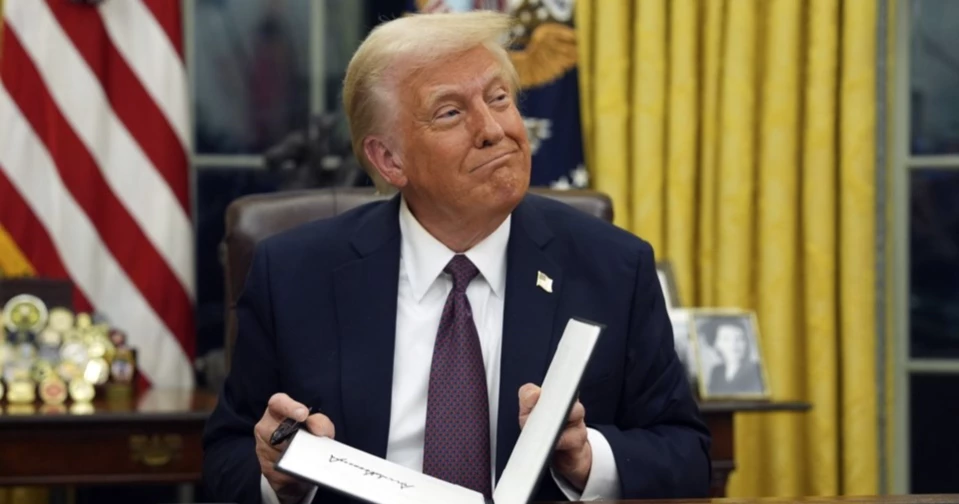
U.S. President Donald Trump on Monday announced his plan to impose a 25% tariff on imports from Canada and Mexico starting February 1. However, he refrained from elaborating on potential taxes on Chinese goods.
Speaking to reporters while signing executive orders on his first day back at the White House, Trump hinted at further discussions with Chinese President Xi Jinping regarding trade relations, following their recent phone conversation. Despite previously threatening tariffs of up to 60% on China during his campaign, Trump noted plans for upcoming meetings with Xi.
“We’ll be having meetings and calls with President Xi,” Trump stated.
Trump sworn in as 47th President of the United States, promises new 'golden age of America'
Trump expressed confidence that his executive actions would help reduce energy prices, curb inflation, and bolster the economy. However, questions remain about whether the measures will meet his promise of a stronger economy with lower consumer costs.
The former president attributed inflation to the $1.9 trillion pandemic relief package introduced in 2021 under President Joe Biden, while accusing the Biden administration of restricting oil drilling.
“The inflation crisis stemmed from excessive spending,” Trump claimed during his inaugural address.
Among the executive orders signed Monday, Trump approved oil drilling in Alaska's Arctic National Wildlife Refuge and eased regulatory restrictions on oil and natural gas production. Additionally, he declared a national energy emergency, aiming to increase electricity production and enhance U.S. competitiveness in emerging technologies like artificial intelligence.
Other measures included a directive for federal agencies to review ways to reduce costs related to housing, healthcare, food, and energy, as well as strategies to increase workforce participation. Trump also extended the timeline for the social media platform TikTok to find a U.S.-based buyer by 75 days.
In trade policy, Trump ordered federal agencies to evaluate tariffs and directed the Treasury and Commerce departments to consider establishing an “External Revenue Service” to collect customs duties.
Trump returning to power after unprecedented comeback
In his address, Trump reaffirmed his commitment to imposing tariffs, claiming foreign nations would bear the cost, although such taxes are typically paid by U.S. importers and passed on to consumers.
“Tariffs will make us rich as hell,” Trump declared.
Canadian Finance Minister Dominic LeBlanc responded to Trump’s announcement, stating that Canada is preparing for various scenarios in trade relations with the U.S.
“Trump has shown unpredictability in the past, so our priority is to be ready for any outcome,” LeBlanc said.
Trump’s orders are part of his broader efforts to tackle inflation, an issue that persisted during Biden's term. While inflation dropped from its peak of 9.1% in mid-2022 to 2.9% in December 2023, prices remain significantly higher than four years ago, with average weekly wages lagging behind.
Trump emphasized his focus on boosting domestic fossil fuel production, arguing it is critical for reducing energy costs and ensuring national security. However, critics noted his apparent disregard for the environmental impacts of fossil fuel reliance. Trump also announced plans to withdraw the U.S. from the Paris climate agreement, citing a need to prioritize domestic energy needs.
What Trump proposed for a second administration
The rising cost of living remains a concern for American voters, with housing shortages and increased energy prices among the key drivers of inflation. Although energy costs account for only 6% of household spending, their ripple effect across the economy is significant.
During his inaugural address, Trump downplayed inflation's impact on voter concerns, suggesting immigration issues resonate more with his supporters.
“How many times can you say an apple’s price has doubled?” he remarked.