
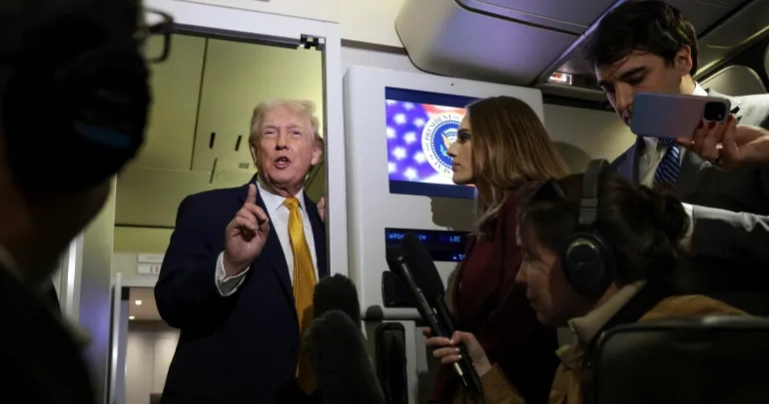
US President Donald Trump has issued fresh threats against Colombia’s President Gustavo Petro and said Cuba appears “ready to fall”, as international criticism mounts over Washington’s seizure of Venezuelan leader Nicolas Maduro.
Trump made the remarks on Sunday while speaking to reporters aboard Air Force One, a day after US forces captured Maduro in Caracas in what Washington described as a law enforcement operation. The comments have fuelled outrage across Latin America and Europe, with several countries warning that the US action sets a dangerous precedent for regional peace and security.
Referring to Colombia and Venezuela, Trump said both countries were “very sick” and accused the government in Bogota of being run by “a sick man who likes making cocaine and selling it to the United States”. He added that President Petro would not remain in power for long.
When asked whether he was suggesting a US operation against Colombia, Trump replied, “Sounds good to me.”
The remarks drew a sharp response from Petro, who urged Trump to stop “slandering” him and warned that Latin America must unite or risk being treated as “a servant and slave”. In a series of posts on X, Petro said the United States was the first country in history to bomb a South American capital, but stressed that revenge was not the answer.
Instead, Petro called on Latin American nations to strengthen cooperation and engagement with the wider world, saying the region should not look only to the north but in all directions.
Trump’s comments came amid growing condemnation of the US operation in Venezuela. Brazil, Chile, Colombia, Mexico, Uruguay and Spain said in a joint statement that they “firmly reject the military actions undertaken unilaterally in Venezuelan territory”. The countries said the operation violated fundamental principles of international law, particularly the prohibition on the use or threat of force, and posed grave risks to civilians and regional stability.
US forces seized Maduro early on Saturday in Caracas to bring him to trial on “narcoterrorism” charges, according to Washington. Maduro has denied the allegations, while critics argue the move was aimed at securing control over Venezuela’s vast oil reserves.
Speaking aboard Air Force One, Trump insisted that the United States remains “in charge” of Venezuela, despite the country’s Supreme Court appointing Vice President Delcy Rodriguez as interim leader. He repeated threats to send US troops back to Venezuela if the country “doesn’t behave”.
Trump also claimed that many Cubans were killed during the US raid on Caracas, adding that a military intervention in Cuba would be unnecessary because the island is already on the brink of collapse.
“Cuba is ready to fall,” Trump said, arguing that the country has lost a major source of income following the halt of Venezuelan oil supplies.
The US president also issued a warning to Mexico, saying the country “has to get their act together” as drugs continue to flow across the border. He described Mexican President Claudia Sheinbaum as a “terrific person” but said drug cartels remain very strong in the country. Trump added that he has repeatedly offered to send US troops to Mexico during conversations with her.
Trump has repeatedly signalled his ambition to expand US influence across the Western Hemisphere, reviving the Monroe Doctrine, which places Latin America within Washington’s sphere of influence. He has referred to his modern version as the “Don-roe Doctrine”.
Analysts say it remains unclear whether Trump will act on his threats or is using them to pressure Latin American governments into cooperation. Experts note that Trump often relies on short, high-profile displays of force to intimidate rivals rather than sustained military engagement.
The US action in Venezuela continues to draw criticism worldwide, with observers warning that escalating threats against multiple Latin American countries could further destabilise the region and undermine international norms.
With inputs from ALJAZEERA