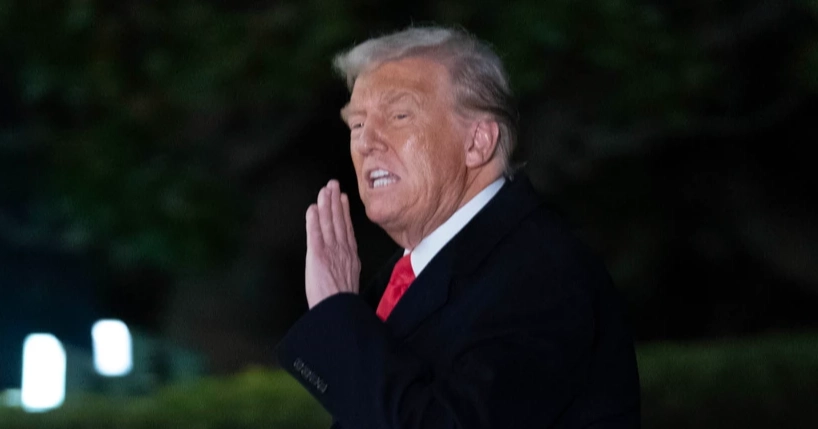
DUBAI, United Arab Emirates (AP) — As President Donald Trump embarks on a tour of Saudi Arabia, Qatar, and the United Arab Emirates this week, the most pressing regional flashpoints he faces lie in Israel and Iran.
Israel has ramped up its military campaign in Gaza following the collapse of a ceasefire two months ago, deepening a humanitarian crisis due to the continued blockade on food, medicine, and supplies. Meanwhile, Iran — Israel’s adversary and Saudi Arabia’s regional rival — edges closer to the ability to produce nuclear weapons.
Trump, however, is expected to focus primarily on Gulf nations where Trump-branded properties either exist or are in development, signaling a focus on economic ties and real estate ventures.
“This is his happy place,” said Jon B. Alterman, senior vice president at the Center for Strategic and International Studies in Washington. “His hosts will be generous and hospitable. They’ll be keen to make deals. They’ll flatter him and not criticize him. And they’ll treat his family members as past and future business partners.”
Still, Trump’s hosts are also deeply involved in the region’s political stability and will likely expect engagement on the crises in Gaza and Iran.
“Trump can easily score a win by reassuring them of America’s strategic commitment to the region, demonstrating consistent messaging and generally rising above the fray,” wrote analysts Elizabeth Dent and Simon Henderson of the Washington Institute for Near East Policy.
Israel Left Off the Itinerary
Trump’s decision not to visit Israel during this regional trip — his first since beginning a second term — has heightened concerns in Israel that its priorities are being sidelined.
This concern grew last week when Trump announced the U.S. would cease airstrikes on Yemen’s Houthi rebels, who are supported by Iran. The group had agreed to stop attacking American vessels in the Red Sea — but the deal apparently didn’t cover their actions against Israel. An Israeli official, speaking anonymously due to diplomatic sensitivity, said the exclusion caught them off guard. Soon after, a Houthi missile launched from Yemen triggered sirens in Israel, and the Israeli military warned it might target Houthi ports again.
Trump’s push to restart nuclear negotiations with Iran has also raised alarms in Israel, which is wary of any deal that might allow Tehran to retain nuclear capabilities or continue backing armed groups across the region.
Israel, which has long eyed a potential strike on Iran’s nuclear infrastructure, was hoping for Trump’s support — an unlikely prospect amid ongoing negotiations. This has led to questions about Trump’s dependability on broader issues, including a hoped-for normalization deal between Israel and Saudi Arabia. Riyadh has insisted any such agreement must include meaningful concessions to Palestinians, a stance unlikely to be accepted by Israel’s current government.
While Israel has paused plans to expand operations in Gaza until Trump’s visit concludes, the U.S. administration’s efforts to broker a new ceasefire appear to have waned. Trump has consistently backed Israel’s actions in Gaza, echoing its view that Hamas bears full responsibility for civilian casualties.
Downplaying the omission of Israel from the president’s itinerary, U.S. Ambassador to Israel Mike Huckabee told Israeli media the visit was focused on economic engagement.
Meanwhile, Hamas announced Sunday that it intends to release Edan Alexander, the last American hostage known to be held in Gaza, as part of a broader effort to establish a ceasefire, reopen crossings, and restore aid delivery to the besieged territory.
No Breakthrough Yet on Iran’s Nuclear Program
The status of Iran’s nuclear program looms large. A notional two-month deadline for a breakthrough in talks has likely lapsed, with U.S. officials reportedly demanding Iran cease uranium enrichment — a condition Tehran considers unacceptable.
Though four rounds of indirect negotiations via Oman have yet to yield concrete results, the talks have advanced to what diplomats call the “expert level,” indicating that detailed proposals are on the table.
In the lead-up to Trump’s visit, Iranian Foreign Minister Abbas Araghchi visited both Saudi Arabia and Qatar — likely aiming to relay messages to Washington and show openness to continued negotiations. Iranian leaders have increasingly suggested they may pursue nuclear weapons, while both Trump and Israel have warned of military action if diplomacy fails.
Iran’s options are narrowing. Its economy has been severely weakened, particularly since Trump withdrew from the 2015 nuclear deal. Its regional network of allies — including Hamas and Hezbollah — has also taken significant hits amid the war in Gaza.
Domestically, Iran faces growing dissent, particularly among women rejecting mandatory hijab laws.
Despite these challenges, one matter continues to unite the Iranian public: the naming of the Persian Gulf. Trump’s reported consideration of officially using the term “Arabian Gulf” was met with outrage.
“This gulf has always been the Persian Gulf — and it will forever remain the Persian Gulf,” said Ayatollah Ahmad Khatami, Tehran’s Friday prayer leader.
Trump’s Return to the Gulf Brings Back 2017 Memories
Trump will begin his trip in Saudi Arabia before heading to Qatar, which recently announced a new Trump-branded development. This warm welcome contrasts with the diplomatic upheaval that followed his 2017 visit.
That trip preceded a major crisis in the Gulf, when Saudi Arabia, the UAE, Bahrain, and Egypt cut ties with Qatar over its links to Iran and alleged support for Islamist groups. The dispute escalated to the point that Kuwait’s late Emir warned during a U.S. visit that military conflict had been narrowly averted.
Initially, Trump backed the boycott, accusing Qatar of “funding terrorism at a very high level.” He later softened his stance and praised Qatar, and the rift was resolved just before President Biden took office.
On Sunday, Trump confirmed that he is willing to accept a luxurious Boeing 747-8 jumbo jet as a gift from Qatar’s ruling family. U.S. officials say the aircraft could potentially serve as a future presidential plane — a gesture raising eyebrows given the extraordinary value of the gift.
With oil prices hovering near $60 per barrel — the lowest since 2021 — Trump no longer has grounds to criticize the Gulf states over energy. The bigger question is how he navigates the region’s deep-rooted challenges and lingering tensions.
To prevent a repeat of the 2017 crisis, Dent and Henderson advised that Trump “should reemphasize efforts to unite the Gulf.”