
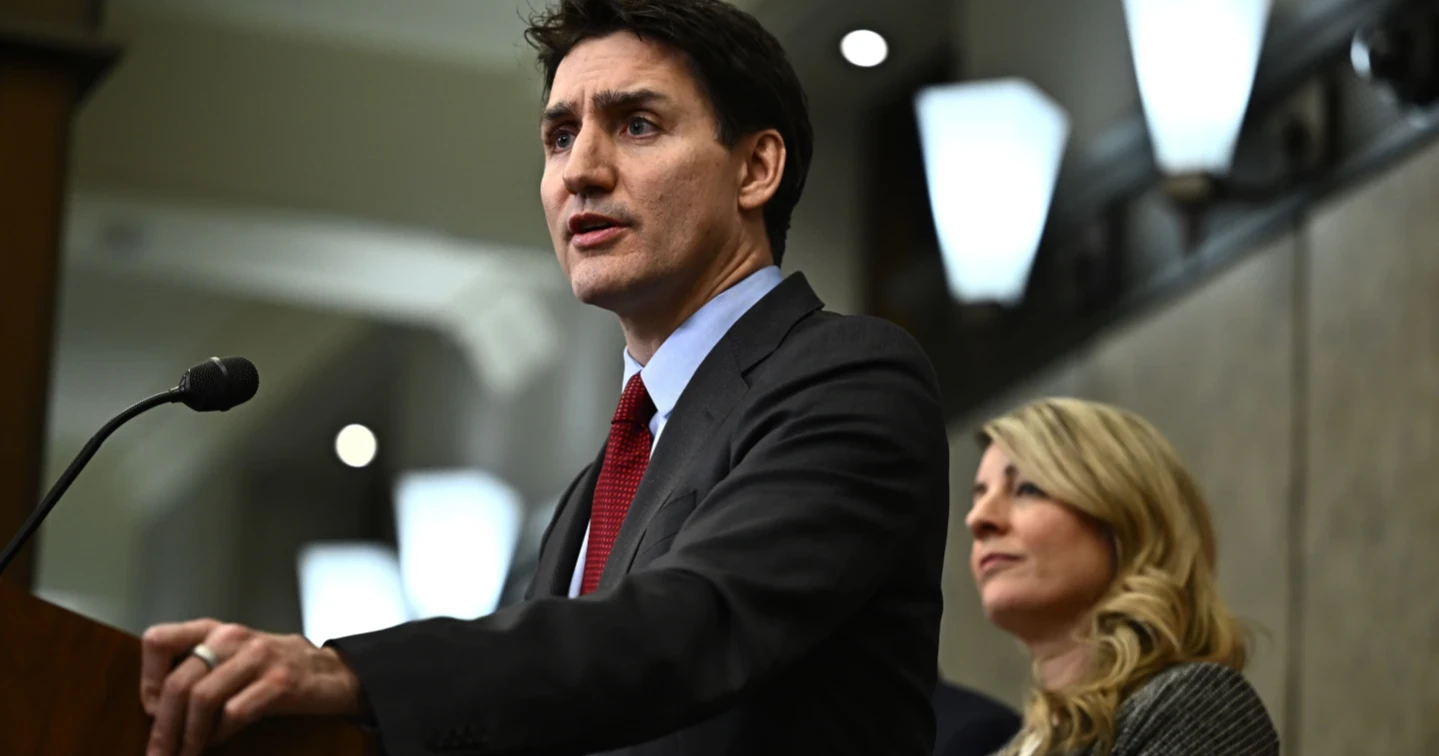
Canada and Mexico have announced retaliatory tariffs on U.S. goods in response to sweeping duties imposed by President Donald Trump, raising concerns among businesses and consumers about the potential economic fallout.
Starting Tuesday, Canada will introduce a 25% tariff on U.S. imports, including beverages, cosmetics, and paper products worth 30 billion Canadian dollars ($20 billion). A second wave of tariffs—targeting vehicles, steel, aluminum, food products, and aerospace goods valued at 125 billion Canadian dollars ($85 billion)—is expected soon.
“We can play the game all they want,” Trump remarked, adding that he plans to discuss the issue with his Canadian and Mexican counterparts on Monday.
While Mexico has confirmed plans for retaliatory tariffs, it has not yet disclosed specific products or rates.
Following the U.S. announcement of new tariffs—25% on Canadian and Mexican goods, with a 10% duty on Canadian oil and imports from China—Canadian Prime Minister Justin Trudeau and Mexican President Claudia Sheinbaum spoke by phone on Saturday. Trudeau’s office stated that both nations are committed to strengthening their bilateral relationship, though Canadian officials stopped short of calling the tariff responses a coordinated effort.
“Now is the time to buy Canadian,” Trudeau urged citizens on social media. “Check the labels. Let’s do our part.”
Canada and Mexico are key U.S. trade partners—Canada being the top export market for 36 states, while Mexico is America’s largest trading partner.
Despite Trump’s warning of further tariff hikes in response to retaliation, Canada and Mexico proceeded with their countermeasures.
“We’re not looking to escalate, but we will stand up for Canada,” Trudeau stated late Saturday.
Several Canadian provinces, including Ontario, British Columbia, Quebec, Manitoba, and Nova Scotia, are taking additional steps, with plans to remove American liquor brands from government-run stores.
Global stocks fall amid rising concerns over Trump’s tariffs
Ontario Premier Doug Ford noted that the province’s Liquor Control Board sells nearly $1 billion worth of U.S. alcoholic beverages annually. “Not anymore,” he declared, confirming that from Tuesday, American products will be pulled from shelves, limiting access for local businesses and restaurants.
On social media, Canadians have begun promoting alternatives to U.S. products.
Addressing Americans directly, Trudeau warned that the tariffs “will have real consequences for you.”
Trump responded by criticizing Canada’s trade surplus with the U.S., claiming that without it, “Canada ceases to exist as a viable country. Harsh but true! Therefore, Canada should become our Cherished 51st State. Much lower taxes, far better military protection—AND NO TARIFFS!”
In Canada, the tariffs have sparked widespread discontent. Trudeau reminded Americans of Canada’s longstanding alliance, highlighting their joint efforts in Afghanistan and disaster relief missions, such as responding to wildfires in California and Hurricane Katrina.
Trump's aid freeze shocks Syria camp housing IS-linked families
The frustration was evident at sporting events, where Canadian hockey fans booed the U.S. national anthem at two NHL games on Saturday. The trend continued at an NBA game in Toronto, where Raptors fans showed their displeasure during the anthem before their match against the Los Angeles Clippers.
At the Raptors game, importer Joseph Chua, wearing a Canada hat, chose to remain seated. “I’ve always stood and removed my hat for the American anthem, but today we feel betrayed,” he said, adding that he plans to avoid U.S. products.
In Mexico, official responses have been measured, with the government emphasizing its preparedness while ensuring the country’s interests are protected.
In 2019, Mexico avoided U.S. tariffs by expanding its National Guard’s role in immigration enforcement. However, this time, Sheinbaum’s government has pushed back against U.S. accusations of links to criminal groups, calling on Washington to address its own issues with drugs and firearms.
Trump justified the tariffs as a measure to curb illegal immigration and drug trafficking across both the northern and southern U.S. borders.
On the streets of Mexico, reactions were mixed.
Carlos Barona, a 40-year-old shop worker in downtown Mexico City, expressed confidence in Sheinbaum’s leadership. “If we survived the pandemic and everything it brought, we’ll survive this too,” he said.
In Mexicali, a border city opposite Calexico, California, some worry about the broader implications. Truck driver Alejandro Acosta, who regularly transports vegetables to the U.S., fears American companies may relocate their operations.
“If they raise taxes on factories here, jobs could disappear,” he warned.
The trade war unfolds as Canada gears up for an election, with Trudeau’s Liberal Party set to announce a new leader on March 9 ahead of an expected spring vote.
“Canada will not bow to a bully,” declared Mark Carney, the frontrunner to replace Trudeau.