
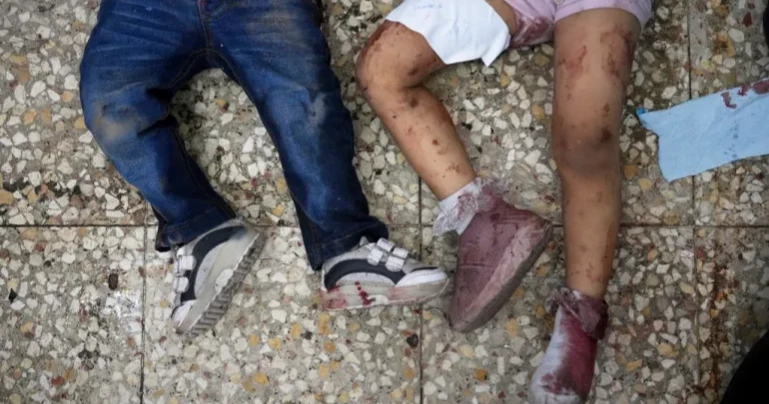
The head of the UN agency for Palestinian refugees has accused Israel of orchestrating a brutal campaign in Gaza, describing it as a calculated effort to cause widespread death and suffering. Philippe Lazzarini, head of UNRWA, said Gaza has become a "graveyard for children and starving people," with residents left to choose between dying of hunger or being shot.
Since May, approximately 800 Palestinians have been killed while attempting to access humanitarian aid, according to the UN. Most of these deaths occurred near sites operated by the Gaza Humanitarian Foundation (GHF), a controversial aid organization supported by both Israel and the United States that has largely replaced the UN-led aid distribution network in the Strip.
Lazzarini’s remarks followed Thursday’s deadly incident in Deir el-Balah, where Israeli forces killed 15 people — including nine children and four women — as they waited for food. That same day, 45 people were reported killed across Gaza, including 11 near a GHF distribution center in Rafah.
UN data shows that since May, 819 people have died near aid sites, with 634 of them killed close to GHF centers. The remaining 185 died near other humanitarian convoys, including UN operations.
At the UN headquarters in New York, the World Food Programme’s Deputy Executive Director Carl Skau described the situation in Gaza as “the worst he has ever seen.” Despite having enough food supplies to support all Gazans for two months, Skau said WFP trucks have not been allowed entry.
With UN efforts sidelined, Palestinians have been forced to rely on the GHF, whose role and placement of aid centers have drawn intense scrutiny. Some analysts argue that the aid distribution system is part of an Israeli plan to push Palestinians into southern Gaza. British-Israeli analyst Daniel Levy said this is part of a deliberate strategy to displace and confine Gaza’s population — an act he likened to a second Nakba, the mass displacement of Palestinians in 1948.
Israel’s plan includes creating a so-called “humanitarian city” in Rafah to house Gaza’s 2.1 million people — a concept critics say resembles a concentration camp.
Despite mounting criticism, GHF claimed on Friday it was “reinventing” aid distribution, using “secure and innovative channels” to deliver supplies directly to those in need.
Escalating Violence and Humanitarian Collapse
By Friday night, Gaza’s Health Ministry reported 45 deaths since dawn. Among them, at least eight were killed in an Israeli airstrike on a school in Jabalia used as a shelter. One witness described finding bodies of civilians — including a young girl — in horrific condition.
Elsewhere, a child was killed and others wounded when Israeli forces hit a house in Gaza City’s Tuffah neighborhood.
Gaza’s hospitals, already overwhelmed and lacking fuel, are on the verge of collapse. The Health Ministry said the lack of electricity is forcing medical facilities to shut down essential services, including kidney dialysis. With too few ambulances, civilians have resorted to transporting the wounded in animal carts.
UN spokesperson Stéphane Dujarric warned that Israel’s restrictions on aid access are endangering countless lives. He said the denial of humanitarian assistance is “life-threatening” and emphasized that every day without a ceasefire adds to the toll of preventable deaths — including children dying in agony and civilians being shot as they try to reach dwindling supplies of food.
Source: AL Jazeera