
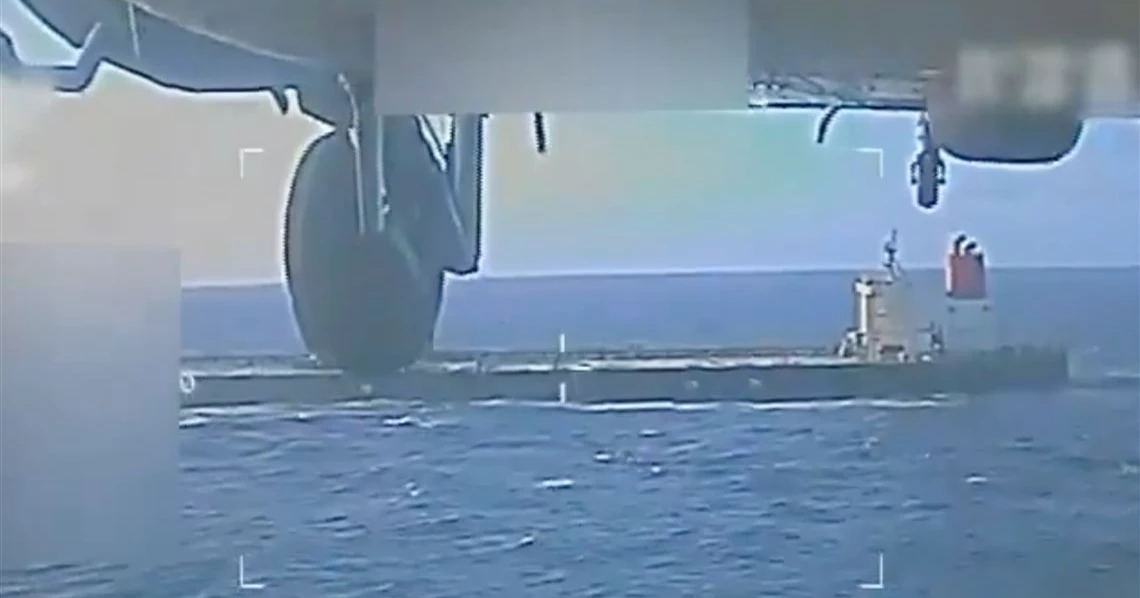
President Donald Trump announced Wednesday that the United States had seized a large oil tanker off the coast of Venezuela, marking a rare military intervention amid escalating pressure on President Nicolás Maduro.
Video shared by U.S. Attorney General Pam Bondi showed Coast Guard personnel fast-roping from a helicopter onto the ship, later moving through the vessel with weapons drawn.
The tanker, identified as the Skipper, carried about 2 million barrels of heavy crude, roughly half owned by a Cuban state-run oil importer. The vessel, previously known as M/T Adisa, had been sanctioned by the U.S. in 2022 for involvement in a shadow tanker network supporting Iran’s Revolutionary Guard and Lebanon’s Hezbollah. The seizure was conducted under U.S. law enforcement authority with Coast Guard support from the aircraft carrier USS Gerald R. Ford, currently in the Caribbean.
Trump described the tanker as the largest ever seized and said it was taken “for a very good reason,” though he provided no further details about the oil’s fate. Venezuelan authorities condemned the move as “blatant theft” and international piracy, claiming it targeted the country’s natural resources.
The seizure follows a series of U.S. strikes on suspected drug-smuggling vessels in the Caribbean and Pacific, as the administration builds a large military presence in the region. Critics, including some Democrats, argue these actions are part of a push for regime change rather than drug interdiction. Senator Chris Van Hollen described the seizure as evidence that the U.S. is seeking to remove Maduro by force.
Analysts say the action could disrupt Venezuelan maritime commerce, potentially affecting the country’s oil-dependent economy. Maduro, speaking at a Caracas rally, did not address the seizure directly but warned that Venezuela is prepared to resist U.S. aggression.
The U.S. military also flew fighter jets near Venezuelan airspace Tuesday, raising further concern over potential escalation. Lawmakers have demanded unedited footage of prior strikes, which Defense Secretary Pete Hegseth said is still under review.