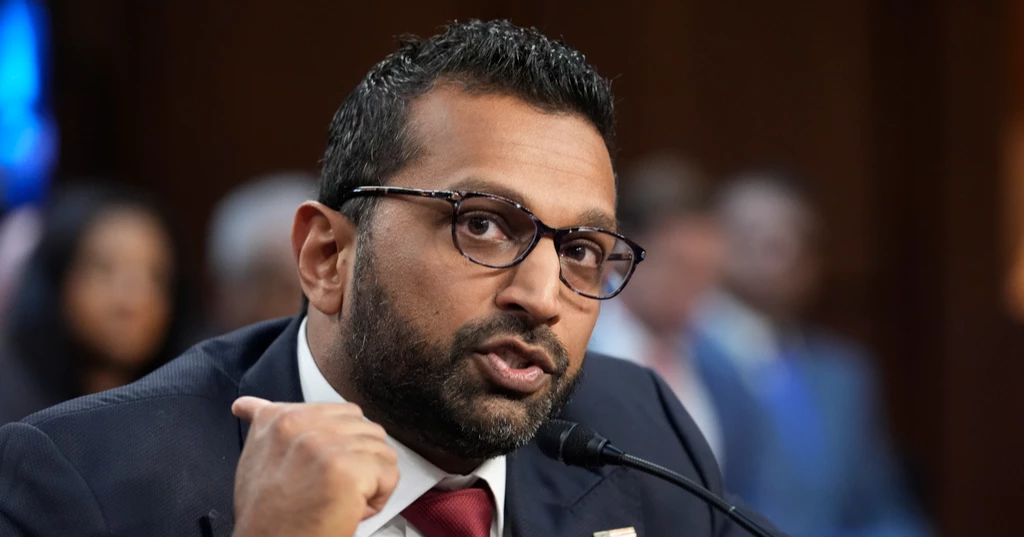
The Senate was poised to vote on Thursday on whether to confirm Kash Patel as the director of the FBI, a decision that could install him at the helm of the country’s leading federal law enforcement agency despite Democratic concerns over his qualifications and the likelihood that he would follow President Donald Trump’s directives.
Patel secured approval from the Senate Judiciary Committee last week with a 12-10 party-line vote and is scheduled for consideration by the Republican-controlled Senate on Thursday afternoon, reports AP.
Trump's FBI director to face skeptical Democrats at Senate confirmation hearing
Barring defections from more than three Republican senators—an unlikely scenario—he is expected to be confirmed. Trump has already managed to get most of his nominees approved despite initial skepticism from some Republicans.
A staunch Trump ally who has strongly criticised the agency he is set to lead, Patel would take over an FBI embroiled in turmoil. The Justice Department has, in the past month, forced out several senior FBI officials and made the unusual demand for the names of thousands of agents involved in investigations related to the January 6, 2021, attack on the U.S. Capitol.
Trump has indicated that he expects some of those agents to be dismissed.
Republicans, frustrated by what they perceive as law enforcement bias against conservatives under the Biden administration and ongoing criminal investigations into Trump, have rallied behind Patel as the right choice. Meanwhile, Democrats have raised concerns over his lack of management experience compared to previous FBI directors and pointed to controversial past remarks that, they argue, call his judgment into question.
“My prediction is if you vote for Kash Patel, more than any other confirmation vote you make, you will come to regret this one to your grave,” said Democratic Sen. Chris Murphy of Connecticut this week.
Patel’s past statements, made in hundreds of podcasts over the past four years, have included calling law enforcement officials who investigated Trump “criminal gangsters,” referring to some January 6 rioters as “political prisoners,” and vowing to pursue anti-Trump “conspirators” within the government and media.
FBI Chief Wray plans to resign before Trump takes office in January
At his confirmation hearing last month, Patel argued that Democrats were misrepresenting some of his remarks or failing to grasp the broader context. He also defended his past proposal to shut down the FBI headquarters in Washington and convert it into a museum dedicated to the so-called deep state. Additionally, Patel rejected the notion that a list of government officials in his book, whom he identified as part of a “deep state,” was an “enemies list,” calling that claim a “total mischaracterization.”
FBI directors are appointed for 10-year terms to shield them from political pressures and prevent them from becoming too aligned with any single president or administration. Patel was nominated in November to succeed Christopher Wray, who was appointed by Trump in 2017 and served for more than seven years but repeatedly clashed with the president and was perceived as insufficiently loyal. Wray resigned before Trump’s return to office.
A former federal defender and Justice Department counterterrorism prosecutor, Patel first gained Trump’s attention during his initial term when, as a staffer on the Republican-led House Intelligence Committee, he helped draft a memo sharply criticising the FBI’s investigation into ties between Russia and Trump’s 2016 campaign.
Patel later joined Trump’s administration, serving as a counterterrorism official at the National Security Council and later as chief of staff to the defense secretary.