
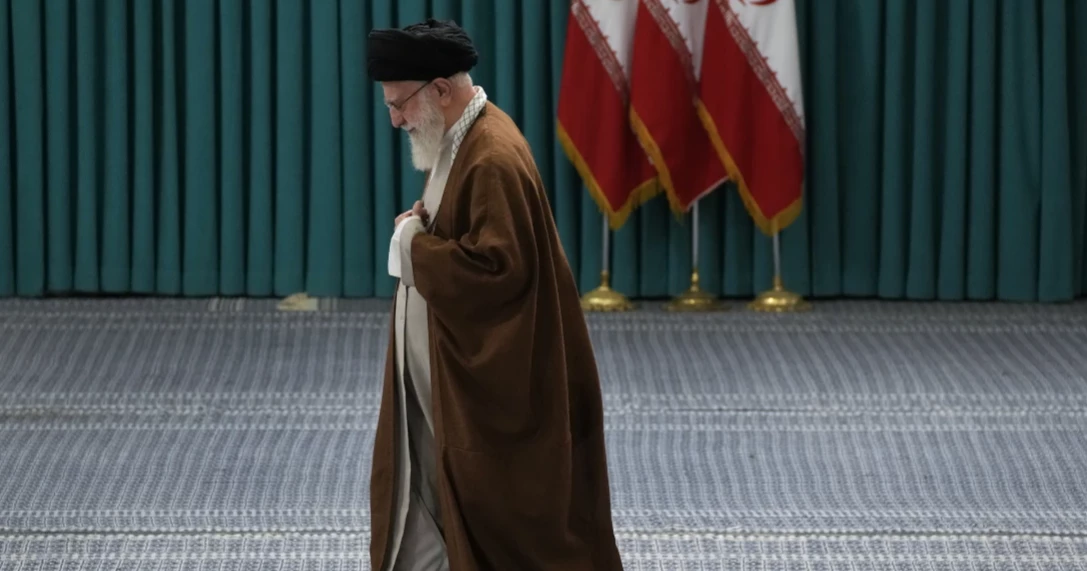
Iran’s Supreme Leader Ayatollah Ali Khamenei, who ruled the Islamic Republic for nearly four decades, has died at the age of 86, leaving the country facing an uncertain future with no named successor.
Iranian state media confirmed his death early Sunday without providing details, hours after US President Donald Trump said Khamenei had been killed in a major new attack by US and Israeli forces and urged Iranians to overthrow the ruling theocracy. As reports of his death spread, some residents in Tehran were seen cheering from rooftops.
Khamenei’s death comes after years of mounting pressure on his leadership. In one of his final demonstrations of authority, he oversaw the deadliest crackdown of his rule, aimed at crushing nationwide protests during which demonstrators openly shouted “Death to Khamenei.”
Even before his compound was reportedly among the first targets of Saturday’s strikes, Khamenei had been under intense strain. Over the past year, Trump had warned that he could have killed the Iranian leader if he chose to, while also blocking an Israeli plan to do so during last summer’s 12-day war.
In recent weeks, as the United States increased its military presence in the region to pressure Tehran over its nuclear programme, Khamenei attempted to deter attacks, warning that any US strike would trigger a regional war. At the same time, he allowed Iran to enter negotiations with Washington over its nuclear activities.
His harsh suppression of protests, which left thousands dead, underscored the depth of public anger. Years of sanctions, economic mismanagement and corruption had already severely weakened Iran’s economy.
Last summer’s Israeli and US bombardment badly damaged Iran’s nuclear facilities, missile systems and military capacity. Tehran’s regional network of allies, including Hamas in Gaza, Hezbollah in Lebanon and the Houthis in Yemen, has also been weakened by Israeli and US strikes since the war in Gaza began, reducing Iran’s influence across the Middle East.
Transforming the Islamic Republic
When Khamenei assumed power in 1989, he faced doubts about his authority. At the time, he was a relatively low-ranking cleric and lacked the religious stature of his predecessor, Ayatollah Ruhollah Khomeini, who led Iran’s 1979 Islamic Revolution.
Yet Khamenei ruled far longer than Khomeini and arguably left an even deeper mark on the country. He firmly entrenched clerical rule, ensuring Shiite Muslim clerics remained at the top of the political hierarchy, setting boundaries for civilian leaders, the military and the security apparatus.
To hard-liners, Khamenei became the ultimate authority, second only to God.
He also transformed the paramilitary Revolutionary Guard into Iran’s most powerful institution, dominant in both military affairs and internal politics. The Guard controls elite forces, oversees the ballistic missile programme and has built a vast business empire, giving it enormous influence over the economy. In return, it served as Khamenei’s most loyal enforcer.
Domestic challenges
The first serious challenge to Khamenei’s grip on power came from the reform movement that won control of parliament and the presidency soon after he became supreme leader. Reformists sought to strengthen the role of elected officials, a move hard-liners feared would undermine the Islamic Republic.
Khamenei mobilised the clerical establishment, and unelected bodies blocked reforms and disqualified reformist candidates from elections. Since then, repeated waves of protest have been met with force.
Mass demonstrations erupted in 2009 over alleged election fraud. Economic protests followed in 2017 and 2019 as sanctions tightened. In 2022, outrage flared again after the death of Mahsa Amini, who had been detained by police for allegedly not wearing her mandatory headscarf properly.
Security crackdowns killed hundreds, with many more arrested amid reports of torture and sexual abuse in detention.
The deadliest crackdown yet
The most recent protests began in late December in Tehran’s main bazaar after the national currency, the rial, plunged to a record low of 1.42 million to the US dollar. Demonstrations quickly spread nationwide.
“Rioters must be put in their place,” Khamenei declared. When hundreds of thousands marched on Jan 8 and 9, security forces opened fire, with veteran protesters saying they were shocked by the scale of force used.
Activists said they had documented more than 7,000 deaths and were verifying additional cases. The government has acknowledged more than 3,000 fatalities, still exceeding previous crackdowns.
Nuclear negotiations
By agreeing to talks over Iran’s nuclear programme, Khamenei appeared to be seeking time to prevent US strikes. However, Tehran rejected Washington’s core demands that it stop all uranium enrichment and hand over its stockpiles.
Trump initially threatened military action to halt the killing of peaceful protesters, later using the threat to push Iran into serious negotiations.
While some inside Iran and within the Iranian diaspora hoped foreign military pressure might bring down Khamenei, others, including many opponents of the regime, opposed outside intervention to topple the system.
No successor
Under Iran’s constitution, a council of Shiite clerics is responsible for selecting the next supreme leader. Several names have circulated, including Khamenei’s son.
Danny Citrinowicz, an Iran expert at Israel’s Institute for National Security Studies, told the Associated Press that a key lesson Iran drew from last year’s war was the need to ensure regime continuity if Khamenei died. He said power could temporarily shift to a small committee of senior officials until hostilities ease.
“It is possible that Khamenei has indicated a preferred successor behind closed doors,” Citrinowicz said. “However automatic implementation of a preselected successor will increase internal friction during war.”
The Revolutionary Guard, now the most powerful force in Iran, could also move to assert control more openly. Such a struggle, involving the Guard and possibly the regular military, could ignite a violent power battle over the oil-rich nation of about 85 million people.