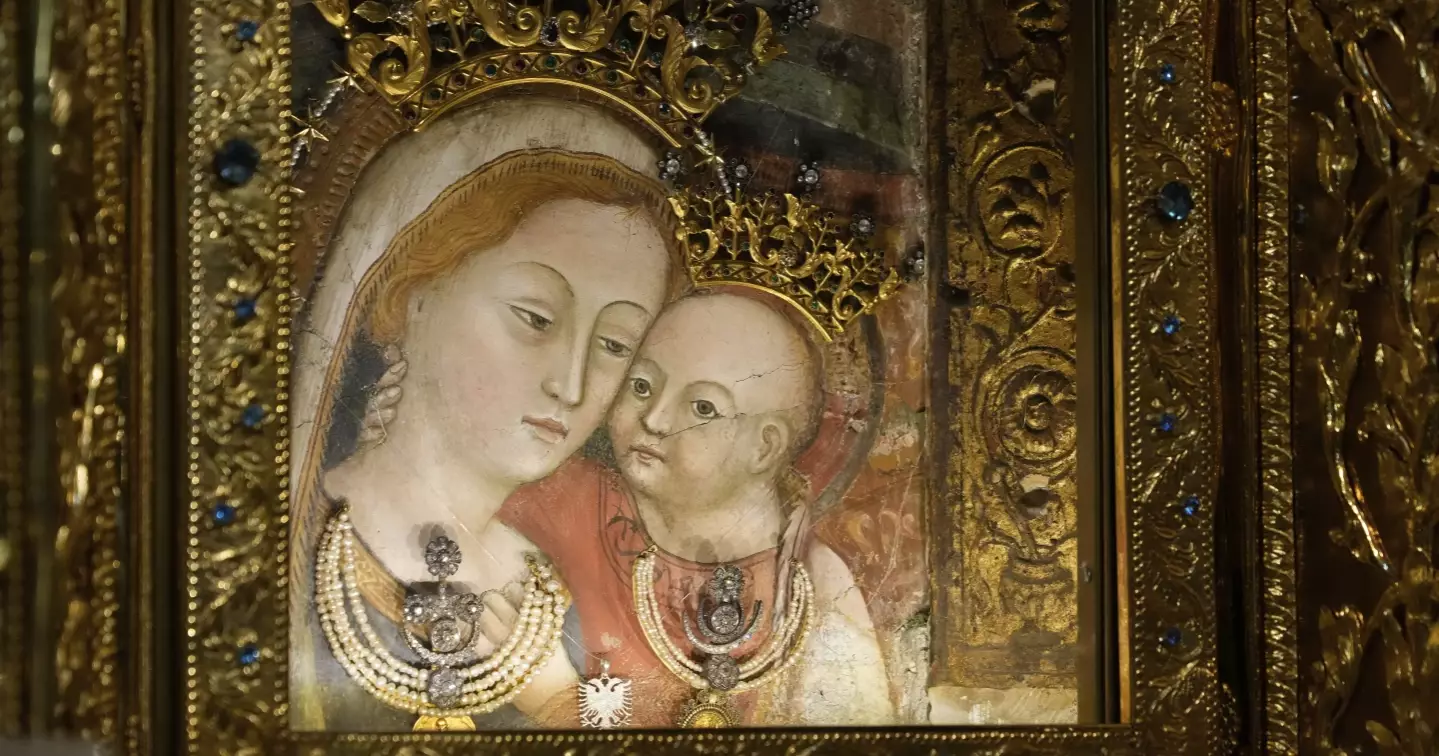
In his first public blessing as pope, Leo XIV concluded with a “Hail Mary,” after commemorating the feast of Our Lady of Pompei. His first papal journey took him to the Sanctuary of Our Mother of Good Counsel in Genazzano, a medieval town, and on his way back, he paused at Pope Francis' tomb inside Rome's Basilica of St. Mary Major to pray.
These are just a few among countless devotions to the Virgin Mary found around the world. Reverence for Mary, from the pope to everyday believers, is deeply rooted in Catholic tradition. Even those only vaguely familiar with religion often recognize the phrase “Hail Mary.”
Since May is dedicated to honoring Mary, it’s a fitting time to explore her significance and why she holds such a central place in Catholic spirituality.
One Woman, Many Titles
Mary, the mother of Jesus, is a central figure in Christian belief. Her role in the incarnation—the birth of Jesus, considered both divine and human—is a cornerstone of Christian doctrine.
Her oldest title is “Mother of God,” or Theotokos in Greek, a term adopted after much early debate in Church history. One of the oldest churches dedicated to her, St. Mary Major in Rome, dates back to the 5th century and was reportedly built following a pope’s dream and a miraculous August snowfall, now marked as the feast of Our Lady of the Snows.
Mary’s titles fall into three main categories: those linked to doctrine and major events in her life (like the Assumption on August 15, which celebrates her being taken into heaven); those tied to reported apparitions (like Our Lady of Guadalupe in Mexico, or Marian visions at Fatima and Lourdes); and titles associated with people’s needs, such as “Our Lady of Good Counsel” or “Star of the Sea,” invoked by sailors.
“There’s almost a Mary for every need,” says Kayla Harris, director of the Marian Library at the University of Dayton in Ohio.
The rosary, one of the most beloved Catholic prayers, reflects Mary’s prominence, and Marian festivals and processions remain key expressions of faith.
A Universal Image in Many Forms
Mary’s depictions vary widely across cultures and centuries. There are “Black Madonnas” like Brazil’s cherished Our Lady of Aparecida, and rarer portrayals of her as pregnant or elderly. She is often shown holding the infant Jesus, highlighting her role in directing the faithful toward Christ.
Catholic teaching emphasizes that Mary is to be venerated—not worshipped, which is reserved for God alone, explained liturgy scholar Giuseppa Falanga.
A Mother to Many
Mary’s appeal also lies in her role as a spiritual mother. Her compassion and accessibility as an intercessor make her a comforting figure for believers. Since the 19th century, the Church has dedicated May to her, a tradition echoing even earlier pagan celebrations of fertility goddesses.
In many countries, including Italy and the U.S., Mother’s Day also falls in May. It was during this season that Pope Leo gave his first Sunday blessing, aligning with another daily tradition of praying to Mary.
At Genazzano’s sanctuary, two mothers attending weekday Mass shared how they pray for their grown children to keep their faith. “The Madonna has guided me since childhood,” said Anastasia Galizia, a local resident who witnessed the pope’s visit. “I ask her how to love her son and I pray for conversion—for myself, my family, and the whole world.”
In Rome’s Basilica of St. Augustine, where Pope Leo’s religious order, the Augustinians, serves, mothers gather to pray to the “Labor Madonna” and to St. Monica, mother of St. Augustine, asking for their children’s spiritual renewal.
“We see many mothers who pray for their children to return to the faith,” said the Rev. Pasquale Cormio, the basilica’s rector.